Friday, January 15, 2010

Pictures from This Week

Some pictures from this week.

These potted plants liven up an otherwise drab corridor in Jerusalem’s Talpiot Industrial Zone:

Corridor of plants

An old editing machine at the Jerusalem Film School:

Film editing machine

The cover of an old book—Hallam’s Literary History, to be exact.

Cover of an old book

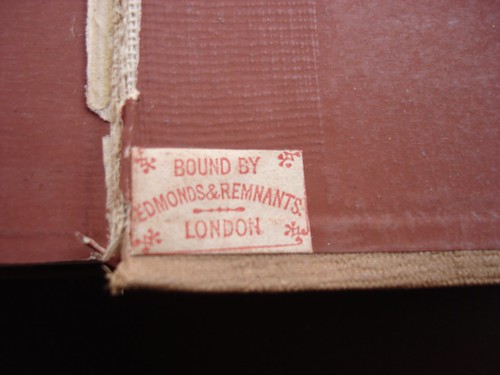
A sticker bearing the name of the company that bound the book:

Sticker inside book

The bookseller’s sticker:

Sticker on inside cover of book

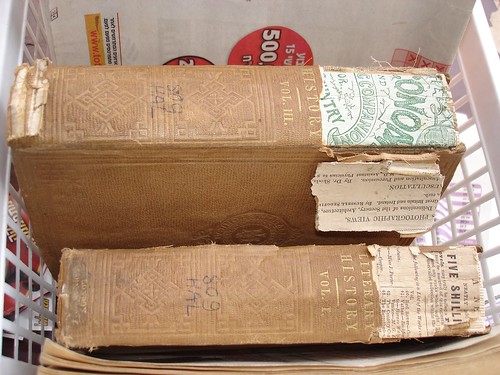
The spines of the books, showing the older paper used in the binding process:

Spines of old books

It makes me wonder: who originally bought those books, and for what purpose? Were they school textbooks? A gift? When and how did they reach Israel?

The imagination soars... and isn’t that what books are for?

Cats About Town

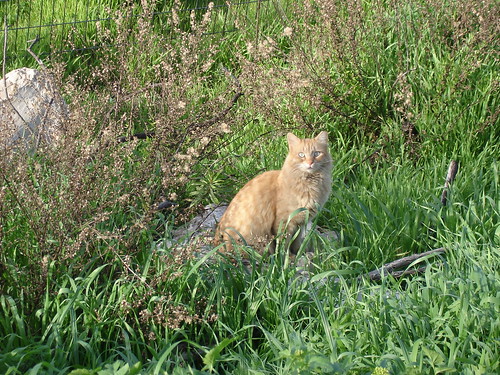
Here’s a lovely orange kitty whom I saw yesterday.

Crossing the old train tracks, no doubt intent on some important feline business:

Orange cat 1

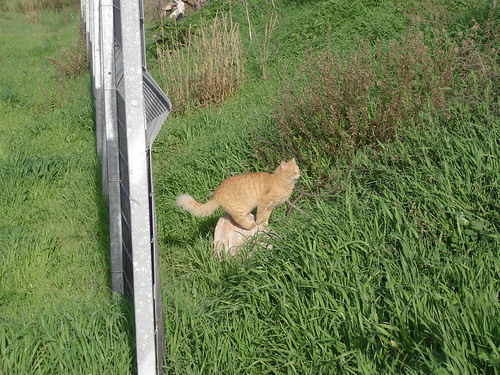
Taking a breather on a rock:

Orange cat 2

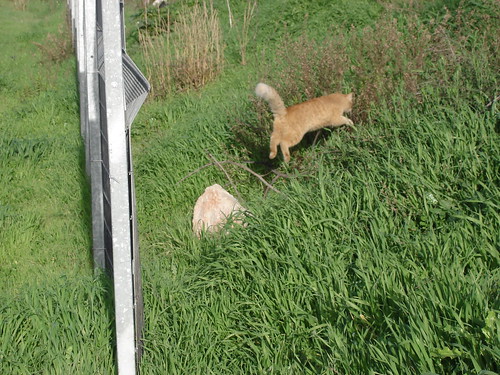
One picturesque leap for cat-kind:

Orange cat 3

“Yes, I know I’m a good model. I’ll be negotiating a catnip clause in my next contract.”

Orange cat 6

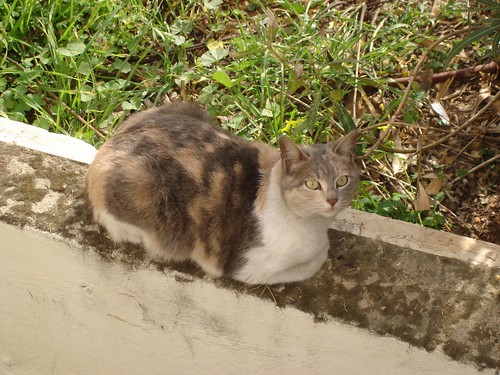
Bonus photo: a dilute calico whom I saw outside a neighborhood post office:

Dilute calico

The Friday Ark. The Carnival of the Cats.

RivkA Nails It

This blog is usually my refuge from politics. Occasionally, I will link to something that speaks to me.

This does.

RivkA nailed it.

Thursday, January 14, 2010

Anat Hoffman on What the Women of the Wall Want

Anat Hoffman’s article, “What the Women of the Wall Want,” has been published in the Forward.

Sunday, January 10, 2010

Catschka the Curious

Catschka asks: “What are you doing with that flashy box?”

Catschka the curious

“And what do you mean, ‘Go back a bit so I can focus’? What’s that focus thing, anyway?”

The Friday Ark. The Carnival of the Cats.

Peer Pressure of a Different Kind

Last Friday, I was in Givat Shaul, a Haredi neighborhood. Here are several things that I saw there.

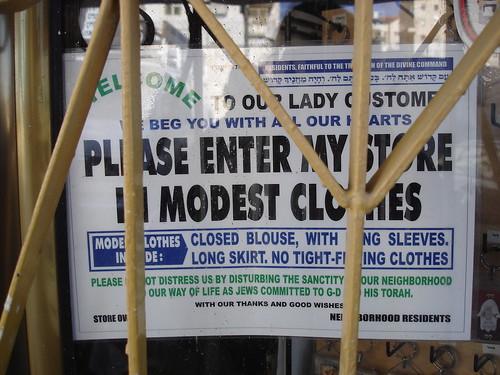
First, a sign in English asking women to enter a particular establishment only in modest dress:

Modesty sign

I can’t help wondering what kind of pressure was exerted on the proprietor to put this sign on his door. I don’t get to Givat Shaul very often, but the last time I was there—a few months ago—I didn’t see this sign. I’ve also seen them in Geula, in Hebrew. This appears to be a recent development. This is the first time I’m seeing such signs in stores or on their doors, and I’ve been here a long time.

To me, the signs are not a polite request but rather a veiled threat. I translate them as follows: “Dress as we tell you to, down to the smallest detail, or we won’t be responsible for what we do.”

(Fine observance of Halakhah, that.)

Now, an outright scare tactic. On this bus station is a printed sign stating that the reason that a No. 2 bus was blown up some years ago was because the passengers were not careful to sit separately. Therefore, the sign says, the power of the mitzvah did not protect the passengers.

Scare tactic

Next to it was this sign:

Sign promoting segregation on buses

Here is my translation, with commentary:

Think before you sit. [The verbs are in the plural, present tense, rather than in the imperative, so that the sign can also be read: We think before we sit. In any case, the idea here is to soften the imperative tone and to give a feeling of in-group, of community, as in: This is what we do.]

Before we board the bus, we think about the most important thing: where to sit?

We all obey the instructions of the great sages of Israel!

Men: in the forward portion

Women: in the inner portion.

Notice that the sign says “inner portion” rather than “rear portion.” In my opinion, that is nothing but a lame attempt to disguise what the sign is really saying:

“Women to the back of the bus!”

After I boarded the bus that I had been waiting for, I found myself wondering what it must be like to grow up in these neighborhoods, bombarded with these messages day after day, week after week, year after year. I came to Jewish observance as a young adult after having had plenty of interaction with the world around me. I had tools for critical thinking and discernment. I also know plenty of older observant Jews who never had to deal with anything like this, and who are as distressed by it as I am.

When I was a child and young adult, I prided myself on my ability to resist peer pressure. (Yes, I was stubborn. Still am.) But usually, peer pressure is pressure to do something that, in one way or another, is not OK.

This is peer pressure taken to the other extreme: to be, as some see it, better and better and better. In a religious community, where the residents have a sincere desire to do God’s will—or, at least, know that they had better show such a desire to their neighbors and friends even if they might not feel it themselves—who can resist this sort of thing? Where will it end? And how will it affect all the people who are growing up in this generation, both now and later on?

Finally, for a bit of comic relief:

Bumper sticker

“Don’t touch me,” the bumper sticker says. “I’m not that kind of car.”

(Click on any photo in order to see a larger version.)

Thursday, January 07, 2010

What You Can Do

I just got a comment on this post that read:

Thanks for the posting the photos along with a detailed explanation of the situation for women. It truly is shocking and discriminatory. Something must be done about it.

You’re absolutely right. So here’s something that you can do to protest the latest outrage: if you’re a US citizen, please write a letter to Israel’s ambassador to the US, Mr. Michael Oren.

Here is the text suggested by Women of the Wall:

Dear Ambassador Oren:

On behalf of the Jewish people fighting for religious pluralism in Israel, I am outraged that one of our leaders, Anat Hoffman, was interrogated and fingerprinted by Jerusalem police on January 5th, 2010. Police told Hoffman, Executive Director of the Israel Religious Action Center and leader of Women of the Wall, that she may be charged with a felony for violating the rules of conduct at what many consider to be Judaism’s most sacred site.

Hoffman’s interrogation came less than two months after the November 18th, 2009 arrest of the Women of the Wall member Nofrat Frankel for wearing a talit and holding a sefer Torah.

We will not tolerate this discrimination and abuse any longer—where women are treated as second-class citizens at a holy and historic place that has great symbolic importance for all Jews.

We are shocked by the brutal and callous insults to which Women of the Wall have been subjected. Many of these curses cannot be repeated in polite company. Israeli police have seen fit to arrest women who go to the wall for peaceful prayer, and make no attempt to reprimand those who spit and curse at them, a stark reminder of the power enjoyed by the Israeli ultra-Orthodox, and their success in forcing their religious practices on an entire nation.

If this were to happen in any other country in the world, the Jewish community would be up in arms. Israel is the rare democracy today that tolerates and even endorses religious discrimination against Jews.

Make no mistake: What appears to be a growing religious crisis in Israel is as much a threat to Israel's survival as are the external threats, and perhaps more so. Israel has shown that she can protect herself from armies and terrorists. Protecting herself from religious extremism may be Israel's biggest challenge—a challenge that cannot and must not be ignored by those who care about Israel’s soul.

We cannot allow this discrimination to continue any further. We must protect our religious rights in Israel.

Pass on our message to the Israeli government, that the Kotel is the beating heart center for the whole of the Jewish people, and not an Ultra-Orthodox synagogue. The arrest and intimidation of women praying at the Wall must stop and it must become a place in which all Jews can pray and connect spiritually to Israel.

Sincerely,


[Your name here]

Interrogation

Anat Hoffman, fingerprinted

I just got off the phone with Anat Hoffman, the director of the Israel Religious Action Center and a former Jerusalem city councilwoman. She asked me to publish the details of her interrogation yesterday at the Kishle police station, which is located near Jaffa Gate in the Old City and was once a Turkish prison. Absolutely, I answered. Things like this should never be kept in the dark, but have the brightest possible light shone on them for all to see.

Anat said: “At the beginning of the session, the interrogating police officer, Senior Staff Sergeant Major (rank in Hebrew: rav samal bakhir) Yoram Suleiman, notified me that I was being interrogated as a suspect in a felony: not complying with a legal order and disturbing the peace.

“The interrogation took place at the Kishle police station. The police got my address from the Registry of Non-Profit Organizations.

“I was asked the following questions:

  1. Do you know what the Supreme Court decision was?
  2. What did the police officer demand from Women of the Wall during their prayer services on Rosh Hodesh Kislev (November 18) and Rosh Hodesh Tevet (December 18)?
  3. Are you a member of the organizing body of these prayer services?
  4. How many women attended?
  5. Did men shout at you?
  6. What did they shout?
  7. (Anat says that the police officer asked her this question in order to find out whether she knew at the time that she was doing something that disturbed the sensibilities of others.)

  8. Were women wearing tallitot [prayer shawls]?
  9. What is a tallit?
  10. Did the women wear kippot [skullcaps]?
  11. Did you hold a Torah scroll?
  12. Did you hold a Torah scroll with intent to read it?
  13. Did you hold a procession in the direction of Robinson's Arch?
  14. Did you say on Army Radio that the aim of your group is to hold a quiet protest against the discrimination against women at the Western Wall?
  15. (Rahel’s note: this question is particularly disturbing. Since when do the police hold a citizen accountable for statements that she makes to the media? Last I heard, Israel was supposed to be a democracy with freedom of speech.)

  16. For what reason do you think there is discrimination against women at the Western Wall?
  17. (Again, I take the liberty of inserting my own note. If you want to know the answer to that question, just go here.)

  18. Do you personally wear a tallit and a kippah?
  19. Is there anything else you would like to add?

“Then,” said Anat, “the police officer took me to the other room, dipped my fingertips in ink and took my fingerprints, just like they do in the movies.”

Anat Hoffman fingerprinted

Women of the Wall has existed since December 1988. I have been a member since 1992. We have never behaved violently toward anyone. Ever. We have been cursed, struck, had chairs thrown at us. In the early days of our group, before I came to Israel, one woman was injured in the head and neck by a thrown chair—the kind made of metal and heavy plastic that used to be at the Kotel, not the lightweight plastic ones that are there now—and had to be taken to the hospital. In November 1996, two men—husbands of members of our group—intervened when a group of several men evidently bent on violence approached us. The police took the two husbands, one of them a rabbi, to the police station for interrogation and allowed the men who had threatened us to go free. Except for one incident that I can recall, as far as I know, the police have never called anyone who threatened us or attacked us to account for their behavior.

But they are treating Anat as a suspected felon—Anat!—who, to the best of my knowledge, has never raised a hand against anyone in her life.

What is going on here? Someone, somewhere, must be feeling very threatened. After all, Women of the Wall has been in existence for 21 years. Why, all of a sudden, is one of our most prominent members being treated as a criminal?

Indeed, what is going on here?

I have no words to describe how appalled, disturbed and outraged I feel over this as an Israeli citizen, an American citizen and a Jew.

No words at all.

(Full disclosure: I am a prayer leader for Women of the Wall—have been for some years now—and know Anat from the group. But even if I had never prayed once with Women of the Wall or laid eyes on Anat in my life, and even if I disagreed with the group for whatever reason, I would still be as horrified over what is happening as I am now.)

Wednesday, January 06, 2010

Booked for Praying

Anat Hoffman, the director of the Israel Religious Action Center and a former Jerusalem city councilwoman, was questioned by police, fingerprinted and told that she may be charged with a felony for helping to organize Women of the Wall’s recent prayer service at the Western Wall. The Forward reports:

Anat Hoffman, director of the Israel Religious Action Center, said that police interrogated her for more than an hour on January 5 about her activities during Women of the Wall’s last monthly service in December. Speaking by phone from Jerusalem, Hoffman said she did nothing differently that day than she had for the 21 years of her group’s existence.
But this incident follows the arrest in November of another member of the group, Nofrat Frenkel, and is contributing to a sense among the women in the organization that the Israeli authorities are stepping up their surveillance and intimidation of activities that challenge the ultra-Orthodox control of the holy site. A spokesperson for the Israeli police said he did not know of the interrogation and declined further comment.

But of course. Doesn’t it make perfect sense? A group of women worshipping at the Western Wall, wearing prayer shawls under their coats, might be so captivated by this small taste of crime that they might join the underworld next. And after we read from Torah scrolls? Kidnapping and armed robbery, for sure.

Either it’s been a very slow day at the police station, or someone in high places is feeling threatened and pulling strings. Anybody want to take bets on which one it is?

In any case, that doesn’t make Anat’s interrogation any less appalling.

Sunday, January 03, 2010

What a Surprise!

I tossed off what I thought was a slightly witty comment to my blogging friend and fellow ailurophile, Elisson... and got this!

Wow, what a surprise! Thank you, Elisson!

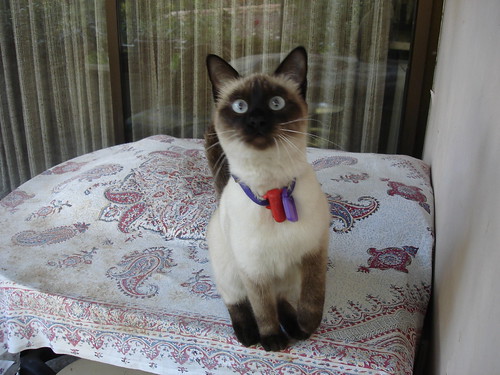
Now, since one good turn deserves another, here are some kittypics for you. First, Her Ladyship and Catschka in mirror poses:

Two cats

Catschka washing Her Ladyship, who graciously accepts her ministrations:

Catschka washes Her Ladyship

Sorry I have no figgy pudding... but I do have a figgy photo:

New figs and leaves

Enjoy, and thanks again!

Thursday, December 31, 2009

God’s Gatekeepers

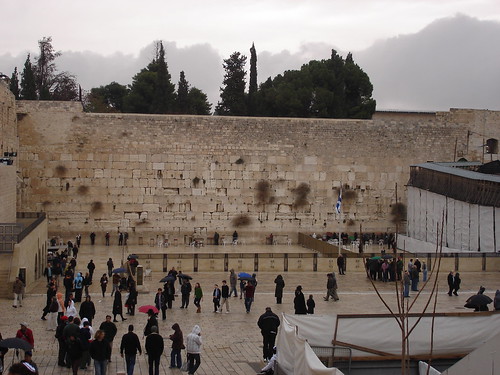
I’ve posted before about the disparity in size between the men’s and women’s sections of the Western Wall. This shot, which I took when I was there yesterday, shows it quite clearly.

The disparity in size

As I’ve written before, I have no problem with the idea of a mehitza—a divider between men and women—at prayer. I like the privacy that it gives me. But I do have a problem with a divider that creates such an unequal situation as the one at the Western Wall, Judaism’s holiest accessible site. Others have a problem with it, too, and are now beginning to speak out. I would have been at the protest candle-lighting in the Kotel Plaza during Hanukkah, but I had to work.

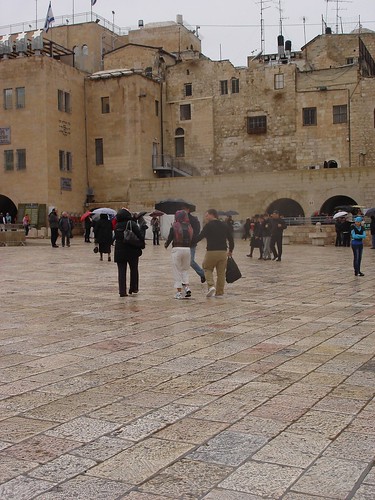
The inequity in space allocation extends indoors as well. The men have a great deal of indoor space that allows them to approach the Kotel directly. The women have much less—in fact, hardly any, and a good portion of what they do have is restricted (see below). Therefore, if women want to pray with full access to the Wall itself, they must crowd into what I’ve come to call the Incredible Shrinking Women’s Section in all weather conditions: punishing sun in summer and cold and rain in winter.

Under umbrellas

At the far right of the Kotel, up a flight of stairs, is a small room where women may pray indoors. I call this tiny room “the classroom” because that is what it looks like to me: a tiny classroom that could seat perhaps ten people comfortably. Many more crowd inside to avoid the rain:

The "classroom"

So I decided, as I have done before, to go inside the Western Wall Tunnels area, where there are both official and unofficial places for women to pray.

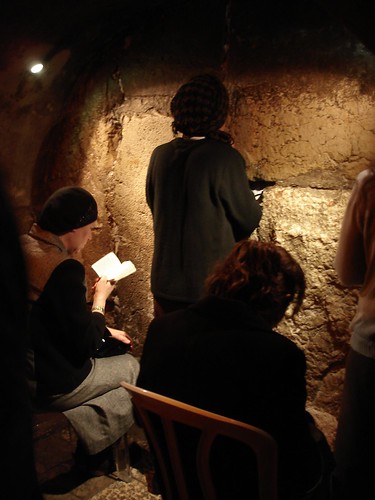
The photo below shows an “unofficial” spot along the passageway that is reputed to be directly opposite the spot on the Temple Mount where the Holy of Holies stood. Women pray here as a matter of course. The spot is also along the route of the Western Wall Tunnels tour, so they are frequently disturbed by tour groups, as we’ll see below.

Women praying opposite the gate

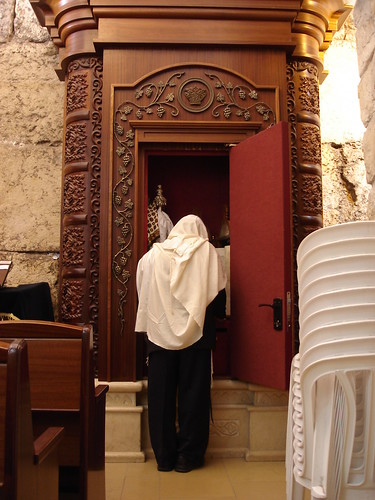
By contrast, directly above this spot is a beautiful, bright, well-appointed synagogue. Women can pray there if there are no men inside... but if men are present, they will ask the women to leave. When one asked me to yesterday and I refused, he took no action, saying only “Be healthy,” a common form of dismissal here. Here, in a photo that I took a few months ago, a man reads from an open Torah scroll in the Ark inside this synagogue:

Reading from the Torah

The official space that has been allocated to the women inside the Kotel tunnels is a balcony enclosed by one-way glass that has no direct access to the Kotel itself. Earphone jacks have been built into the walls so that women relatives of boys celebrating their bar mitzvah will be able to hear the service from inside.

Earphone jacks

As with the outdoor section, another disparity prevails: men may enter the women’s section, but no woman may enter the men’s section for any reason. Men’s space is sacred space. Women’s space is not. Here, a worker enters the women’s section in order to gain access to a supply closet that is located there, directly inside the prayer area.

Male worker in women's section

Back outside, near the spot along the tour route where women pray, a tour group passes by:

Tour group passing by

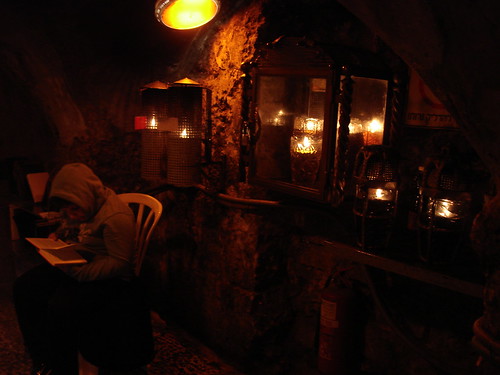
The flash makes the area look much brighter than it actually is. The photo below reflects the amount of light more accurately. Oil lamps burn opposite the gate, relieving the dimness somewhat:

Opposite the gate

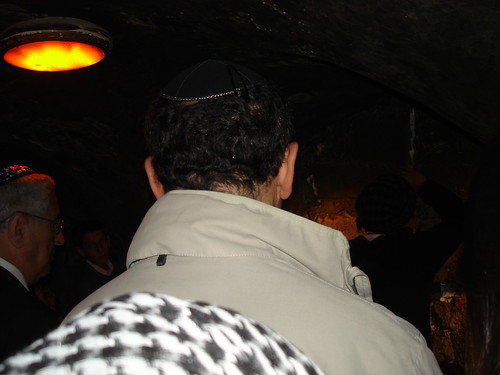
When the tour group passed by, the guide told them that they could pray there if they wished. They stopped right behind the women who were sitting there and praying. One of the men on the tour, pictured at the left of the photo, recited Psalm 130 in melodic Hebrew, in Mizrahi style. I got the feeling that if he was not religiously observant, he was at least traditional and familiar with the sources and prayer customs, probably from a young age. Yet there he was, praying right alongside the women.

Men praying at the gate

I had to do quite a lot of work in order to reach that spot myself. When I tried at first, two guards barred my way. I was surprised; I’d never had a problem getting there before. I watched, incredulously, as the guards let other individuals in, both men and women, even as they told me that I could go no further and one of them went so far as to block me with his body. When I asked why they were allowing the others in and not me, the guards answered that the others had permission. “How do I get such permission?” I asked. They told me to go back to the guard at the front desk. I did.

At first the guard did not want to let me in, explaining that the spot was open to the general public only between the hours of 3:00 a.m. and 8:30 a.m. At all other times, he said, it is closed to the public, open only to tour groups and to individuals by special permission. (I did not see this information posted anywhere in the Western Wall Plaza.) I pointed out that other women were praying there and that the guard had allowed other people inside as I watched. The guard at the front desk said that those individuals had received special permission. I persisted, and eventually he gave me that permission... when I had pleaded enough.

“You have five minutes,” he told me. “There are cameras there, all over.”

Good grief, I thought. What does this man think I’m going to do there?

Here is the gate where I was stopped. (I note, with irony, the presence of the Israeli flags in the photo. The Western Wall is supposed to be a national site, open to everyone equally.)

The gate that bars the way

Here are the feet of the guard who stopped me. The edge of the book that he is reading—presumably a prayer book or book of Psalms—can also be seen:

The guard's feet

When I was on my way out, the guard at the entrance stopped me again and began to reprimand me, saying that he had done me a great favor in letting me into the tunnels. “There were other women there too,” I pointed out. He bristled. “Are you arguing with me?” he asked aggressively. “Do you want to argue with me?”

“You let them in even though it’s well after 8:30 in the morning,” I told him. “They have problems,” he said, indicating that he had let them in as a favor—as he had done with me. “I turn lots of people away. But I let them in. And I let you in.”

As I listened to this man, who evidently fancied himself God’s own gatekeeper, I grew more and more shocked and disgusted by his attitude and by the unfair and arbitrary way in which the regulations were enforced. Finally, I could take no more. “Enjoy your power,” I said, and walked away. He called after me, “Is that how you talk to me? Is that how you talk to me?”

Now, before my half-dozen readers jump all over me: I know that I should have kept my mouth shut. But I simply couldn’t bear his arrogance for one moment longer.

When I told this story to an Israeli-born friend, she remarked, “Eved ki yimlokh” (a servant who becomes a ruler; Proverbs 30:22). Israelis routinely use this phrase to express their disgust with petty bureaucrats on power trips.

Back outside, the sign does not mention a word about when the tunnels are open to the public for prayer:

Sign without times

Here are the rules to be observed in the Western Wall Plaza. No word there about any 3:00 a.m. to 8:30 a.m. opening times either:

The rules to be observed at the Western Wall

Up along the plaza is a passageway for men only. I can’t help wondering who funded it.

Passage for men only

The entrance to the office of the administrator in charge of the Western Wall, often erroneously referred to as the rabbi of the Kotel, as in this sign:

Office sign

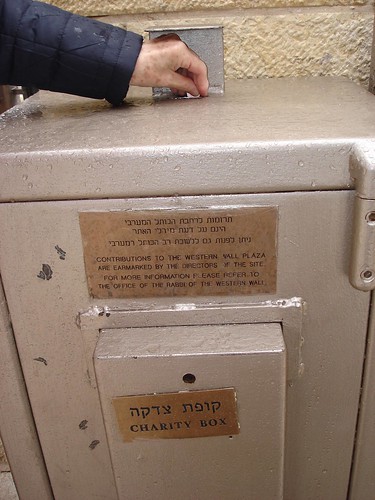
A charity box located near the women’s section that also contains the mistaken phrase “rabbi of the Western Wall.” (Someone made a donation just as I was taking the photo.)

Charity box

But as I was leaving, I saw something lovely. In the middle of the plaza, a young man was on one knee before a young woman. Both looked delighted. As I passed by, I flicked a quick and careful glance at them just at the moment that the young man was putting a ring on the young woman’s finger. I walked on, then turned around. The young man and woman were hugging, and the woman was standing on tip-toe to reach him. Then a friend joined them, and they left the plaza. Here they are, from the back and from a distance:

After the proposal

Tuesday, December 29, 2009

Catschka Goes Hunting

Catschka went hunting the other day. While she is an expert climber, she is not yet an expert hunter. The birds survived. A pictorial account follows.

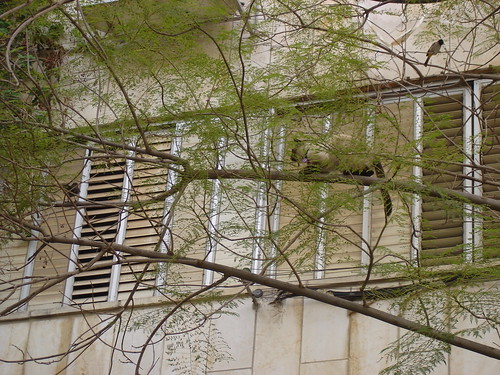
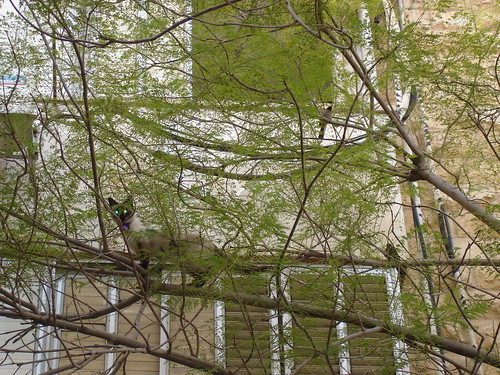
Catschka cautiously makes her way along the tree branch. Her goals: the chickadee above and the blackbird below. “Slowly, slowly... a hunter needs patience above all....”

Catschka hunting

The blackbird and the chickadee catch sight of Catschka. The blackbird scoffs. “There she is. The mighty huntress. Yawn.”

Catschka and the blackbird

The blackbird draws Catschka to a thinner part of the branch, farther out on the tree, where it’s impossible for her to pounce. Catschka follows. Then, just before the bird hops off the branch, she realizes that she’s been tricked and gives vent to her rage. “I’ll get you for that! Just you wait until I get my teeth into you! I’ll make you into mincemeat, you ben yonah!”

“Call me a pigeon, will you?” the blackbird fumes. “A pigeon?! I’ll have you know, you lumbering four-footed fur-visaged feline, that I am descended from an impeccable line of blackbirds. And my friend there is a chickadee. Do you see any pigeons in this garden? No? Too bad for you—they’re the only birds who’d be stupid enough to let you catch them. Ben yonah indeed!”

Catschka faces off with bird

Catschka, her uncaught quarry behind her, admits defeat. “I’ll be back,” she snarls.

Catschka admits defeat; bird taunts

Having survived the Great Avian Taunting, Catschka climbed out of the tree several moments later and received skritches (not pictured) by way of consolation.

The Friday Ark. The Carnival of the Cats.

Monday, December 21, 2009

Hashmieeni: Gender Segregation Hotline for Women in Israel

Via the Kolech website (in Hebrew, so here is a quick, free translation of the relevant information):

The new Hashmieeni hotline was recently established to help women deal with issues related to public space in Israel—specifically, involuntary gender segregation in the public space. The hotline operates on Mondays, Wednesdays and Thursdays from 3 to 5 p.m. at 02-671-1911. Here is Hashmieeni’s Facebook page. Here is Hashmieeni’s Twitter page. Their email address is hashmieeni at gmail dot com.

The name, Hashmieeni, comes the following italicized phrase in Song of Songs 2:14: “O my dove, in the cranny of the rocks, hidden by the cliff, let me see your face, let me hear your voice; for your voice is sweet and your face is comely” (JPS 1985 translation; emphasis mine).

The creeping increase in gender segregation in public space here needs to be addressed urgently. More power to Hashmieeni.

Tuesday, December 15, 2009

Menorah of Courage

This post originally ran on May 4, 2005.

Menorah in window opposite town hall of Kiel, Germany, 1933

There is a famous photograph of a Hanukkah menorah in a window opposite the town hall of Kiel in Germany. The year is 1933, and the building that the menorah faces is decorated with a Nazi flag. The photograph always makes me think of David and Goliath, except that here, David did not dispatch the enemy with one blow. Instead, it was Goliath who attacked—with unparalleled cruelty and viciousness—and David who survived, after bleeding almost to death.

I saw the photograph for the first time in A Different Light, a book about Hanukkah. Soon after I got it, I read it from beginning to end and discovered the photograph, which made a strong impression on me.

Several months after I received the book, I spent Shabbat with friends of mine in a town near Jerusalem. At lunch, a woman at the table asked: “Has anyone ever seen the menorah at the home of the M. family? It appears in a famous photograph”—and she proceeded to describe the very same picture I had seen in the book. I couldn’t believe my ears. The M. family lived on the same street where I was staying, only a few houses away from my friends’ home.

After Shabbat I went to the M. family’s home and asked to see the menorah. The family graciously allowed me to look at it, touch it and hold it, and they told me its story.

The menorah had belonged to the town rabbi, a direct ancestor of the M. family. At approximately the time the photograph was taken, the rabbi denounced the Nazis from his pulpit. Understanding the danger he was in, his congregants begged him to get out of Germany, and although he resisted at first, in the end they persuaded him. He immigrated to pre-state Palestine together with his family, who brought the menorah with them.

When I got home later that night, I e-mailed the author of the book. “You’ll never believe what I just saw and held,” I wrote. The author put me in touch with an archivist at the Holocaust Museum in Washington, DC, and in turn I put her in touch with the M. family. The story of the menorah and the rabbi who defied the Nazis from his windowsill and from his pulpit is now properly archived in the museum.

Recently the M. family was blessed with a grandchild. As he grows up, he will learn the story of his courageous ancestor and the menorah he brought from darkness to light.

Sunday, December 13, 2009

Driving with Dad

Many years ago, when I got my learner’s permit, both my parents would take me out to practice driving. One weekend, as I drove with Dad on some back-country roads, he suddenly said to me, “Pull over.”

I obeyed.

Once I had stopped the car at the side of the road—which was deserted—Dad asked me, “Do you see what you did wrong?”

I was utterly confused. I tried to think of some driving mistake that I’d just made, but I couldn’t.

Then I saw the twinkle in Dad’s eye.

He gestured softly with his hand. On the little hill in front of us, in plain sight, a deer was grazing.

After a few moments, the deer caught sight of us and ran off. Dad smiled at me, I smiled back, and we drove on.

Saturday, December 12, 2009

Three Cats

Seen around town over the past several days:

A tuxxie poses for a portrait:

Portrait of a tuxxie

A local kitty enjoys some tree bark:

Enjoying

A kittycat guards a nearby building:

Guarding the building

The Friday Ark. The Carnival of the Cats.

Thursday, December 10, 2009

Dvir, Bardy and Mistaken Identity

I first met Dvir Cafri through the English-speaking folk community in Israel, and more specifically through my dear friend Joanna, who started our group, Et al. Dvir is a fantastic musician—he plays guitar and sings beautifully.

Dvir is also a translator who owns his own business, Bardy Translations. He’s hard-working, honest and dedicated. I’ve often seen him take out his laptop and get cracking during rehearsal breaks, when the rest of us were standing around shooting the breeze. Dvir takes his work, and his deadlines, seriously.

Dvir is also the victim of a particularly unfortunate case of mistaken identity.

There’s another guy out there, a Yaron Broderson, who also calls himself Uriel Bardi, who also conducts business in the translation field. In both Hebrew and English, there is only a single letter’s difference between Broderson’s alias, Bardi (ברדי in Hebrew), and the name of Dvir’s long-standing translation company, Bardy (בארדי in Hebrew). Unfortunately, Broderson is—how shall I say this politely?—nothing at all like Dvir, and the business community has gotten wise to that fact. Customers are warning each other against Broderson, apparently with good reason (at least one journalist has written about his alleged acts of fraud and other improper practices)—but as Murphy’s Law would have it, Dvir has been catching some of the fallout due to the similarity between the name of his business and Broderson’s adopted alias. Apparently, quite a few people think that Dvir, rather than Broderson, is the one to be avoided.

So I wanted to get out there and say: listen, people, you’ve got the wrong guy. I’ve known Dvir Cafri of Bardy Translations personally for quite a few years now. Dvir is honest, decent and diligent. His firm, Bardy Translations, is excellent and reliable.

Dvir Cafri is not Yaron Broderson. He has no connection with Broderson or with his alias, Uriel Bardi, in any way whatsoever. Nor is there any relationship at all between Bardy Translations and the alias, Bardi, that Broderson adopted.

Dvir is also a wonderful musician, if you should ever happen to need one.

And if you ask nicely, I’m sure that Dvir would be willing to show you photos of his wife and little daughter, who must be two of the luckiest ladies in the world.

Oh, one final thing. Dvir didn’t ask me to write this post. I wrote it on my own initiative when I heard what had happened, and got Dvir’s permission to post it afterwards.

Tuesday, December 08, 2009

A Conversation Long Ago

Rahel, as a child: “Dad, what happens to the waste from the bathrooms on ships?”

Dad: “It gets pumped into the sea.”

R: “Ew, gross!”

Dad, cocking an eyebrow: “And where do you think the whales do it?”

Sunday, December 06, 2009

In Memoriam: Dad

JASKOW, Ralph S. 83, of Tarpon Springs, passed away Nov. 22, 2009. He was a graduate of the Wharton School of Business of the University of Pennsylvania, 1943. He sailed as a Staff Officer in the Merchant Marines during the Korean War. He was also the Marine Personnel Director of Seatrain/Hudson Waterways. After retiring from the Merchant Marines, Ralph worked for the Orange County, New York Accounting Department. Ralph was also an expert craftsman. Services were held in New Montefiore Cemetery in New York. Ralph is survived by his devoted wife of 50 years, Selma; daughters Susan and Robin; brother Louis and sister Dorothea. Ralph was a very kind, gentle, ethical man who will be deeply missed.

My mother, my sister and I wrote this obituary in the meeting room of the funeral home the day after Dad died. Afterwards, we agreed that while it was well written, it didn’t come close to describing him. There are so many stories for each phase of his life... and Dad was a master storyteller. I wish that he had written his stories down.

When I was in elementary school, I had to describe what my father did for a living. The simplified version was “He puts people on ships.” In reality, it meant that my dad assembled the crews for his company’s merchant ships, and he was on call 24/7. If a crewman got into trouble on the other side of the world, my dad was instantly on the phone trying to help him out, and also to fill his position on the ship that was now missing a crew member. (For this reason, my father’s company paid our long-distance telephone bills throughout much of my childhood.) Since my father had been a merchant seaman himself—he was at sea for six years after graduating from college—he often spoke as a seaman during these conversations: “Aye, Cap’n,” and spelling out his letters and numbers the way they did when he had been at sea, not all that long before—for example, pronouncing the word “nine” with two syllables in order to distinguish it from the word “five” on a faint and static-filled overseas telephone connection.

I grew up taking telephone messages from crewmen from all over the world, many of whom had accents I had no prayer of understanding. But Dad understood them all.

I remember, deep in the mists of my childhood, hearing a story about how Dad went to The Tombs, a notorious prison in New York, in dreadful weather in order to bail out a crewman who had gotten into trouble. From wisps of conversation that I heard as a child, I figured out that Dad helped many other people in ways that no one will ever know about.

In his capacity as a staff officer aboard ship, it was my father’s duty to take crewmen who had broken the law to the brig. He told me how much he’d disliked that part of his job.

Once, a crewman on one of Dad’s voyages got drunk and went berserk. He grabbed a knife and started to threaten everyone in sight. The other crewmen ran to their rooms as fast as they could and slammed their doors. Only one door opened: my father’s.

Dad came out of his room, stood face to face with the drunk crewman and asked him, “What are you doing?”

“Purser, I like you,” the crewman told him, raising his knife. “I don’t want to do this.”

“If you don’t want to do it,” my father asked the crewman calmly, “then why are you going to?”

The crewman paused for a moment, and as he did, another crew member jumped him and disarmed him, preventing what could have been a terrible disaster.

As part of his work as Marine Personnel Director of his company, Dad got jobs at sea for young people just out of high school. Even as he was preparing to retire from his position, he used his still-current knowledge of the field and contacts to help a friend of mine apply for a job as a radio operator at sea after he (my friend) graduated from college. (That friend has since gone very far in his chosen field, and remembers my father fondly.)

Dad used to joke that my sister’s and my friends had better be nice to us... or they’d wake up seasick!

Dad was an avid do-it-yourselfer and a master craftsman. I remember him making wood pictures (from the kits supplied by the Constantine company) that he then gave as gifts, doing car repair, priming the pump of our artesian well whenever it ran dry, building our deck, showing me how to paint, and gardening. For many years, he had a subscription to Organic Gardening magazine, and kept a compost heap in the back yard. He taught me what leaf mold was, and was pleasantly surprised when I guided him to a large quantity of it that I found during a hike in the nearby woods. My sister and I grew up eating the vegetables that he and my mother grew in our little garden, and enjoying the plants and flowers that my parents cultivated both inside and outside the house.

Dad had a gift with numbers—he did our family’s taxes for years—and an incredible sense of humor. He also had a strong sense of fun and the gift of gab: he could (and sometimes did) convince unsuspecting friends and family members that their homes were sitting on top of an oil well, for example. Afterwards, they all had a good laugh.

He had an amazing sense of direction and could navigate by the stars.

Dad had the most beautiful blue eyes I have ever seen. I have blue eyes, too, but they are not as bright or as beautiful as Dad’s, which reminded me of blue topaz with a hint of aquamarine. When I was on my way to the US to see him for the last time, a Passport Control official looked at my passport and then at me to make sure that I was who I said I was. Then he said, “You have amazing eyes.” I answered, “They’re my father’s.” He said, “Well, then, give them back!” (He had no idea what was going on, of course. But I still almost dissolved where I stood.)

Dad enjoyed giving us things that he knew we would like. He knew how much I loved cats, and when I was in high school, he introduced me to one of my favorite novels, Jennie by Paul Gallico. (I recommend it highly. It isn’t only about cats—though it’s clear from Gallico’s writing that he loved and understood them—but also about friendship and love.)

No matter what the weather or temperature, Dad took long walks every night with our dog, Sam, whom he loved, and who loved him. (It was the only male bonding he had in our house, outnumbered as he was by a wife and two daughters!)

On Saturday mornings, he woke me up to go to acting school in New York City, and drove me there and back. On Sunday mornings, he woke me up for Sunday school at our local synagogue, singing Irving Berlin’s song, “Oh! How I Hate to Get Up in the Morning.”

We lived in the country for most of my childhood, and often during the summer, bees and wasps would fly into our house. I can still remember Dad saying, “Don’t kill it!” and trying to chase it out the window instead. To this day, whenever I find a spider or other insect, I trap it and take it outside because of what Dad taught me all those years ago: never harm another creature unnecessarily.

(The day after he died, I was closing a window in my parents’ place—now my mom’s place. A lizard was caught between the glass pane and the screen. I could hear Dad’s voice in my mind saying, “Let it out! Don’t make it suffer!” I thought back: Dad, show me how to open the screen so that I can let it out! A second later, I managed to get the screen open and gave the lizard a gentle nudge with my fingertip. In a flash, it scooted out to freedom.)

Dad loved poetry. Many years ago, he copied poems that he loved into a little black three-ring binder that he had, and even wrote some of his own. (See the bottom of this post for several examples.)

Dad enjoyed making what he called “Rice Krispies Candy” with Rice Krispies cereal and marshmallows. I can still taste it... it was delicious!

Dad had an excellent sense of time. I still remember one occasion when we were waiting for the school bus to pick me up to take me on a trip. He saw the bus from far off and said, “Your bus will be here in ninety seconds.” We both looked at our watches. The bus’s tires came to a full stop on the ninetieth second.

Everyone who met Dad said that he had class. When his condition worsened to the point that he needed constant care, he made sure to thank everyone who cared for him. My mother says that whenever Dad wanted something, he always asked her for it politely, and always thanked her. Two days before he died, when he could barely move or speak, he asked me to tip the home health care aide who had come to bathe him. (I tried, but the aide would not accept tips.) After the home health care aide left, my father asked me whether I had given him the tip, and I explained that I had tried but that he would not accept it. During both these exchanges, Dad was having a great deal of difficulty breathing. It was so hard for him to speak... but he insisted on doing what he thought was right, and on following up.

Dad’s death was peaceful, and even at the moment of his passing, he gave us a gift of humor that I will write about soon. Even through our tears, we crack up with laughter at the memory, and imagine that Dad, wherever he is, is laughing himself silly over it as well.

Dad died with my mother, my sister and me by his side—a blessing for which I am profoundly grateful.

Dad had home hospice care during the last several days of his life. God bless the people of the Suncoast Hospice, who made such a sad and painful experience that much more bearable for Dad and for us. And God bless Mom, who insisted on keeping Dad at home and caring for him, keeping him alive much longer than his doctors believed possible, and for getting him that care, so that his last days would be as comfortable and dignified as they could be.

Click on the following pictures in order to see larger versions.

My father as a young man:

My father as a young man

A poem that Dad liked, entitled “A Ship Comes In.” My uncle—my father’s older brother—read it at Dad’s burial.

A Ship Comes In

My father’s clock. He made the wooden casing and embroidered the clock face (after asking my grandmother to teach him how to embroider).

My father's clock

A poem by my father, “Still Voyager.” He did not date the poems that he wrote, but I believe that he wrote this one after his six years at sea, when he took a job on shore.

"Still Voyager," a poem by my father, Ralph S. Jaskow
“Still Voyager” by Ralph S. Jaskow
The river, on its way to sea,
Flows gleaming past my desk and me;
And laughing, leaves the tower high
Where I am prisoner in the sky.
(Guard well the man whose thoughts may be
On rivers that run down to sea!)
The train that takes me home to bed
Becomes, at times, a ship instead;
And, with a white sail all aquiver,
I pass my office on the river.
(Watch well o’er him whose soul has fled
The train that takes him home to bed!)
Each ship on which I sail away
Founders upon the reef of day.
Come nine o’clock and comes the hour
When you will find me in my tower.
(A curious place for me to stay,
Whose heart in ships has sailed away!)
(© Estate of Ralph S. Jaskow)

May the memory of my father, Ralph Sternfeld Jaskow, be for a blessing.

I miss him so.