Saturday, September 17, 2005

Where the Furry Things Are

The Friday Ark is up at the Modulator, and this week’s Carnival of the Cats will be at Watermark this Sunday at ... well, very late at night my local time.

Enjoy!

UPDATE: COTC is up! Head on over for lots of wholesome kitty goodness.

Friday, September 16, 2005

Ever Have the Feeling You’re Being Watched?

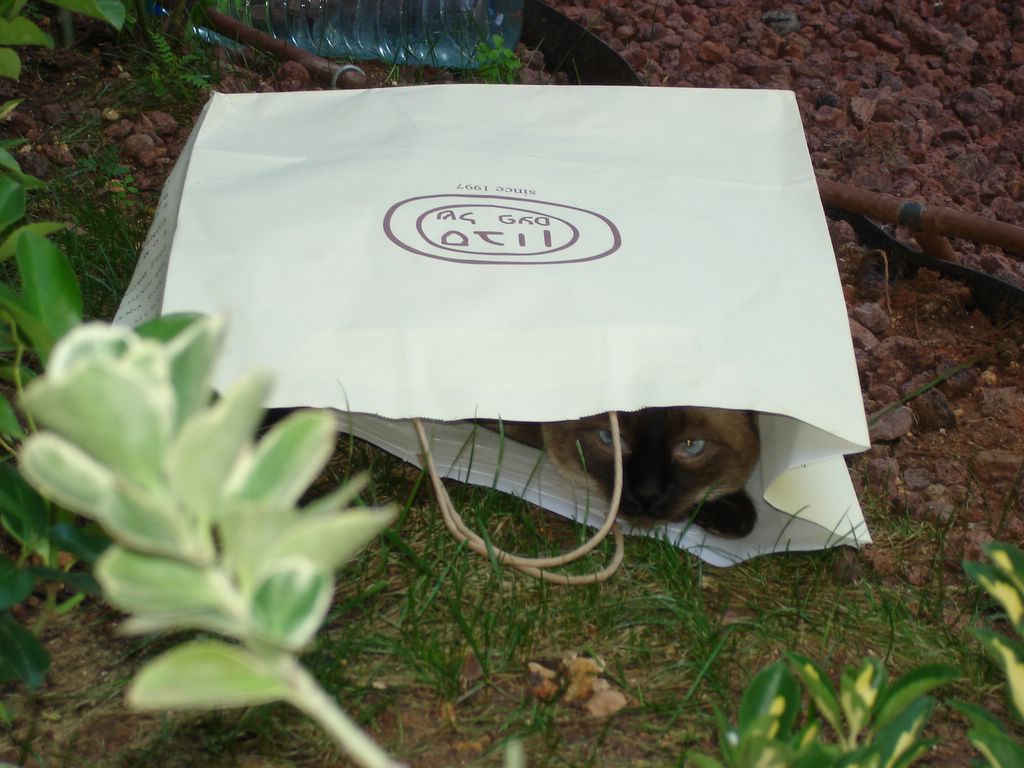
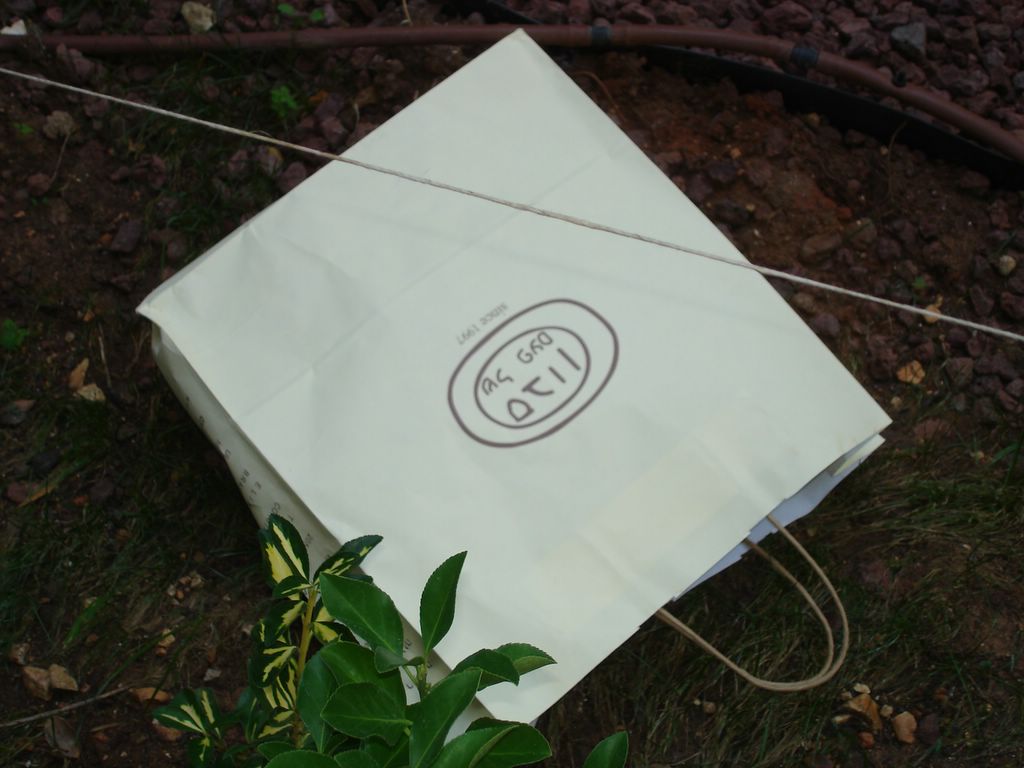
This looks like an ordinary paper bag ...

An ordinary paper bag?

... but it actually contains some extremely sophisticated surveillance equipment.

Her Ladyship in the paper bag

Seriously, that’s Her Ladyship supervising me as I add more plants to Catnip Row.

The Resilient, Resinous Almond Tree

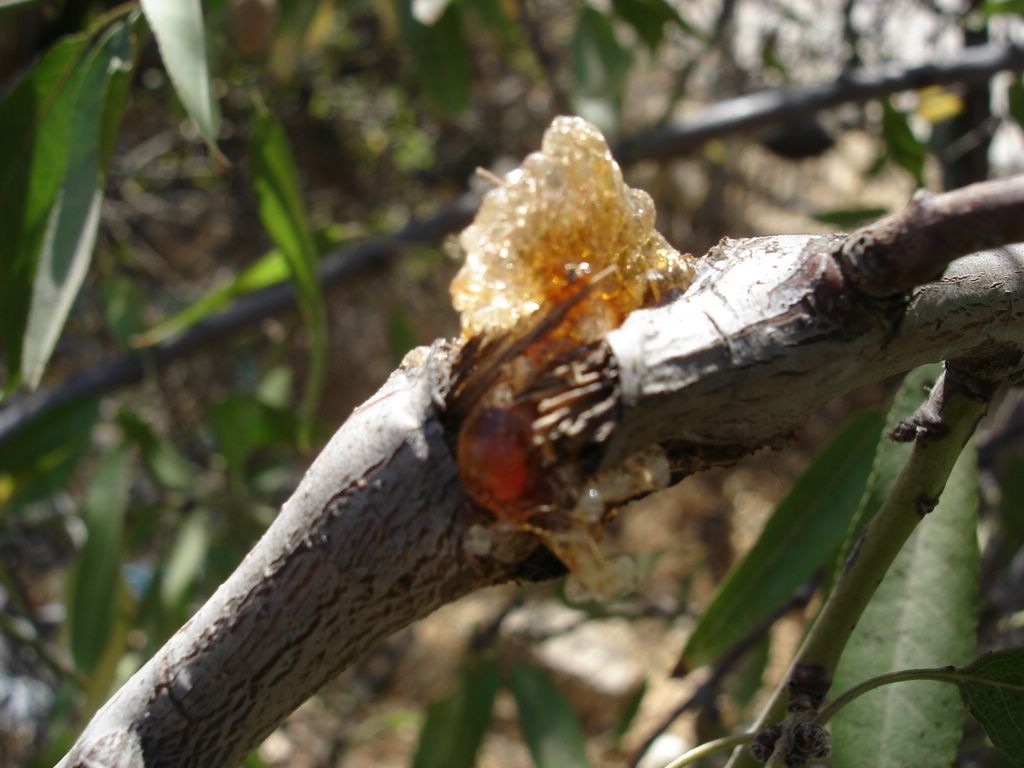
There is an almond tree near where I live. Today, I saw something amazing on it.

Almond tree resin

Although the branch had been almost severed, a bead of tree resin healed it so completely that there are now healthy leaves on the other side of the break.

Leaves on the other side of the resin bead

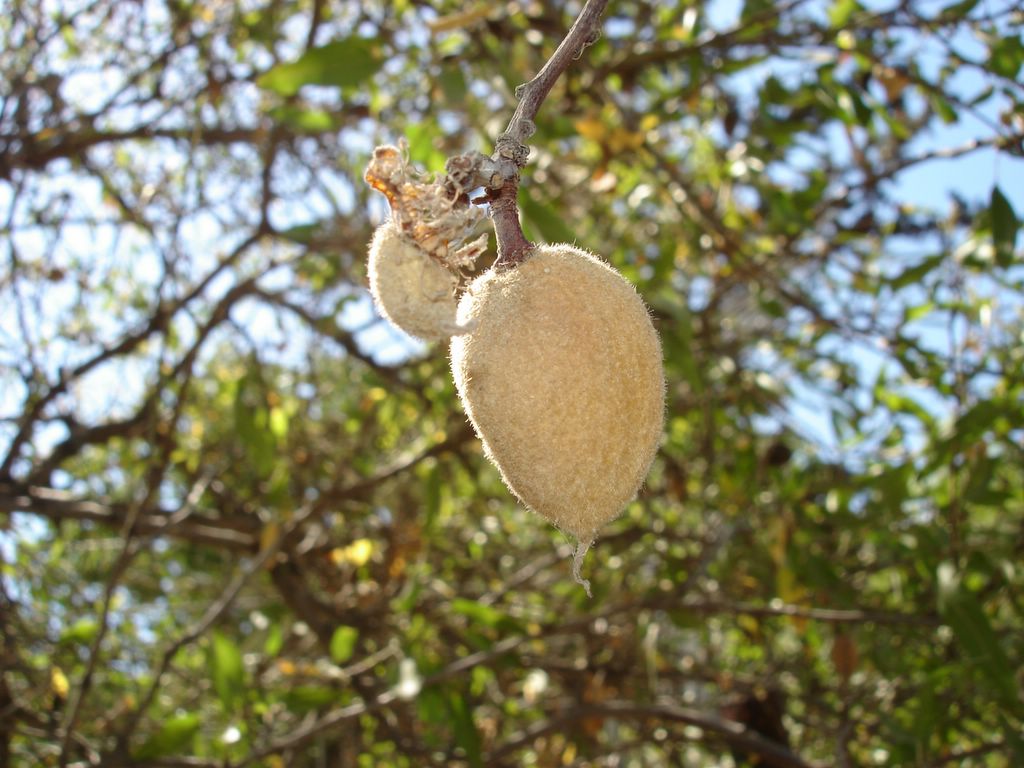
Finally, this picture is for Meryl. Sometimes you do feel like a nut.

Almond on tree

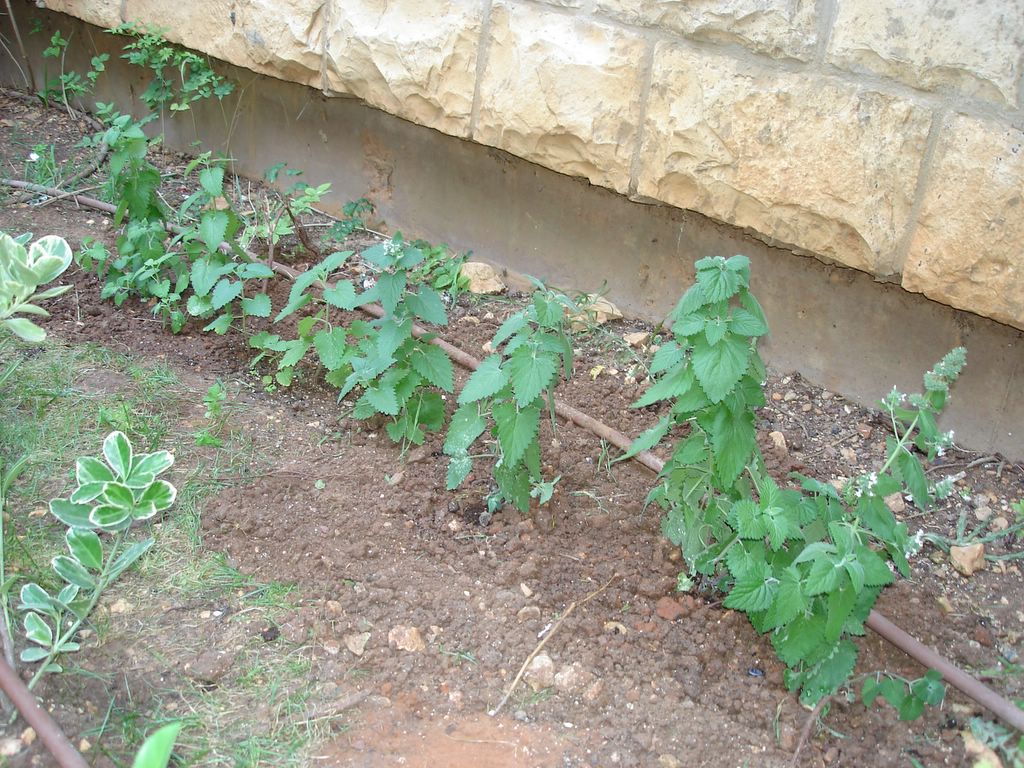
Catnip Row

Ladies and gentlemen, welcome to Catnip Row.

Catnip row

For your convenience, there is fresh water at the garden entrance. Safe, shady places are located in the various corners of the garden where you may rest until the effects of the catnip have passed.

The line forms to the right. Please wait your turn politely and keep your claws sheathed.

Thursday, September 15, 2005

The Jerk Tax

Israelis have an almost legendary disdain for restrictions or limitations. While this disdain has led to some of our most stunning achievements, it has also brought about a great deal of tragedy, specifically on our highways. News broadcasts regularly include the number of people killed in traffic accidents, and nearly every day a photograph of a crushed vehicle with a heartbreaking caption appears in our newspapers. Nevertheless, point out to many Israeli drivers that they are breaking the law and they may tell you—politeness optional—that the law doesn’t apply to them. “I’m a good driver,” they may say. “The law is only for people who don’t know what they’re doing. A road accident? Nah. That’ll never happen to me.”

The problem, of course, is that it happens all too often.

Israel has suffered from a high road accident rate for years. Only recently has the government formed its own organization to deal with the problem, while citizens’ groups like Metuna and Anashim ba-Adom (People in Red) have been around for at least a decade. Some years ago Metuna offered a course it called KEY, an acronym of the Hebrew phrase kol ehad yakhol (everyone is able). The goal of the course was to teach ordinary citizens how to report traffic violations legally and effectively, thus giving them the power to improve the situation on our roads.

It sounded like a good idea to me. I took the course, and I’ve been reporting traffic violations ever since.

(Now, before anyone starts thinking about using this method to get back at that noisy neighbor they can’t stand, I should clarify that according to the rules, you can’t report someone you know. There are quite a few other rules, too, which I won’t go into here. But just to make it clear: there are precise regulations about reporting traffic offenses. It’s not a free-for-all.)

I still remember our instructor telling us: “If another driver cuts you off or does something stupid, don’t get mad. Get even.” In this case,“getting even” didn’t mean taking the law into our own hands. Rather, it meant using the law to make sure that traffic rules are enforced and obeyed. It meant that finally, ordinary citizens could hold bad drivers accountable instead of merely fuming about their selfishness and stupidity. Also, if other drivers knew that the person they were about to cut off might report them (meaning that they would have to pay a hefty fine), they might think twice about doing it. And the more drivers who obey the law, even out of pure self-interest, the more lives are saved.

Have I been responsible for people being fined? Yes. In fact, I have a name for it. I call it the Jerk Tax.

Here’s how I came up with the name.

Several years ago I was riding in a sherut (a kind of shared taxi) to a town outside Jerusalem. The driver began talking on his cellphone without using a hands-free device, a dangerous and illegal act (and, actually, dangerous even with a hands-free device). His attention wandered, and the van in which we were riding began to weave in and out of its lane. The passengers started to feel uneasy.

Finally, a woman riding with several small children succeeded in getting the driver’s attention. “Please stop talking on your cellphone while you’re driving,” she begged him. “It’s not safe. I’m worried about my children.”

“Don’t tell me how to drive, lady,” the driver shot back, continuing to talk on his cellphone. “Shut up. I know what I’m doing.”

Ignoring the woman’s repeated pleas, the driver continued to berate and insult her as he talked on his cellphone and kept weaving in and out of his lane.

All right, I thought. That’s it. Not only is this driver endangering all of us, but he’s acting like he has a perfect right to do it. And look at how he’s treating that poor woman. He’s behaving like a total jerk, and he thinks he can get away with it. Well, not this time.

I reported him. Several weeks later, I received a letter from the police’s traffic-safety unit. They had followed up on the case and slapped the jerk—I mean, the driver—with a hefty fine.

Thus the concept of the Jerk Tax was born.

Recently, when I stayed at the home of some friends over Shabbat, we had a discussion about the situation on our highways. As my friends lamented the state of affairs, I told them that they can do something about the problem and illustrated my point with the story above. One of their other guests, a young woman from the United States, seemed disconcerted and asked me: “Aren’t you being just a little too happy about having gotten somebody in trouble?”

I answered, perhaps a bit more harshly than I intended: “What I’m happy about is that we can actually do something about bad drivers in this country. And as for ‘getting people in trouble,’ we’re not in grade school anymore, where it’s not nice to rat on people. Sometimes it’s necessary. That driver could have gotten us all killed!”

But yes, I have to admit it: in a world where the jerks seem to win so much of the time, it does feel good to make some of them pay the Jerk Tax now and then.

The Un-PC Stroller Ramp

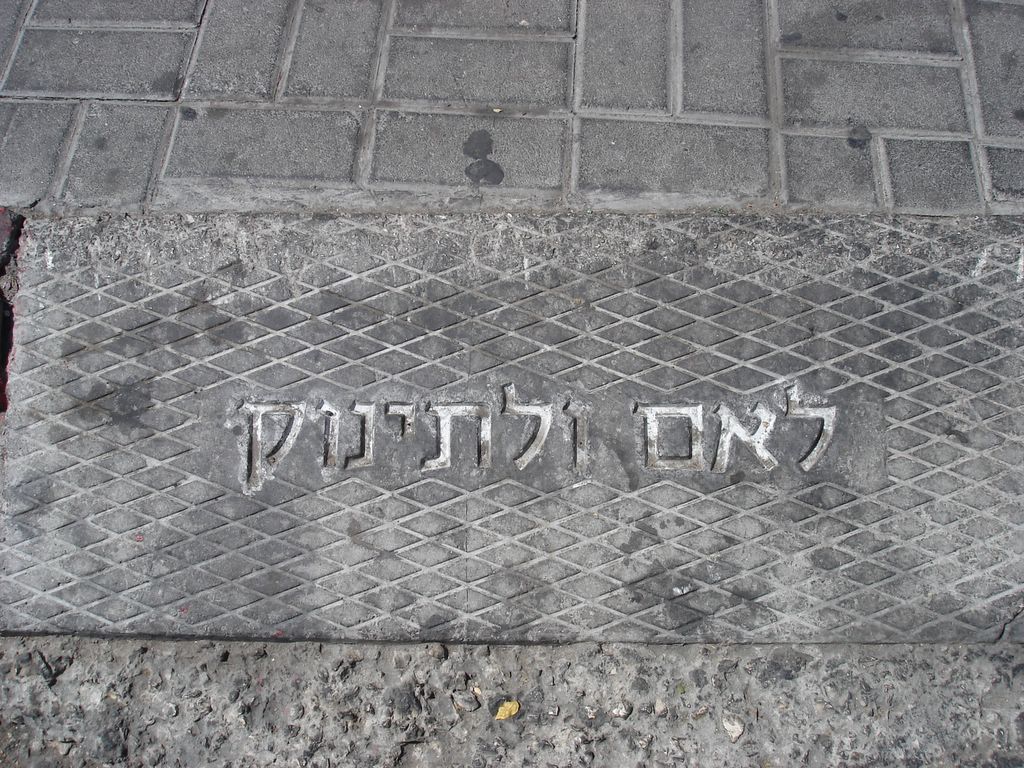
This is a stroller ramp located near the Russian Compound in Jerusalem.

Stroller ramp

The Hebrew reads La-em ve-la-tinok—“For mother and baby.”

So I have to ask: What about the fathers? These days plenty of daddies push strollers, too.

I wonder how old these ramps are, actually. I enjoy seeing things like this because they give us a window into the mindsets of a different time, which was actually not all that long ago. Fascinating.

Now, if you want to see something really old near the Russian Compound:

Column

I am not sure about the story of this column. I seem to remember reading that it was in the process of being chiseled out of its surrounding stone and was left unfinished. If any readers know the story, I’d appreciate it if they would leave a note in the comments. Thanks!

Wednesday, September 14, 2005

Buy a CD, Help Katrina Survivors

I don’t usually talk about my CD here, but today I’m making an exception.

CD Baby, the wonderful on-line store that sells my CD, “Day of Rest,” recently added a feature that allows artists who sell their CDs there to donate all their profits directly to the American Red Cross. (Here is CD Baby’s gallery of artists who have chosen this option.)

“Day of Rest” is participating, too. For the next thirty days (longer if there’s sufficient interest), all profits from sales of “Day of Rest” will be donated directly to the American Red Cross to help survivors of Hurricane Katrina rebuild their lives.

So head on over to CD Baby’s donors’ gallery, get yourself some good music and make a donation at the same time. (Just look at all those categories. There’s bound to be something you like in there. And you can listen to sound clips of every disc, too.)

You don’t even have to buy “Day of Rest” in particular. Any CD from CD Baby’s Red Cross donation gallery will do.

You get good music, the Red Cross gets a donation and the artist gets a mitzva. Everybody wins.

Monday, September 12, 2005

Haveil Havalim #36

... is at Velveteen Rabbi this week. (Oooh, 36! Double hai!)

Sunday, September 11, 2005

Mitzi, the Railway Station Kitten

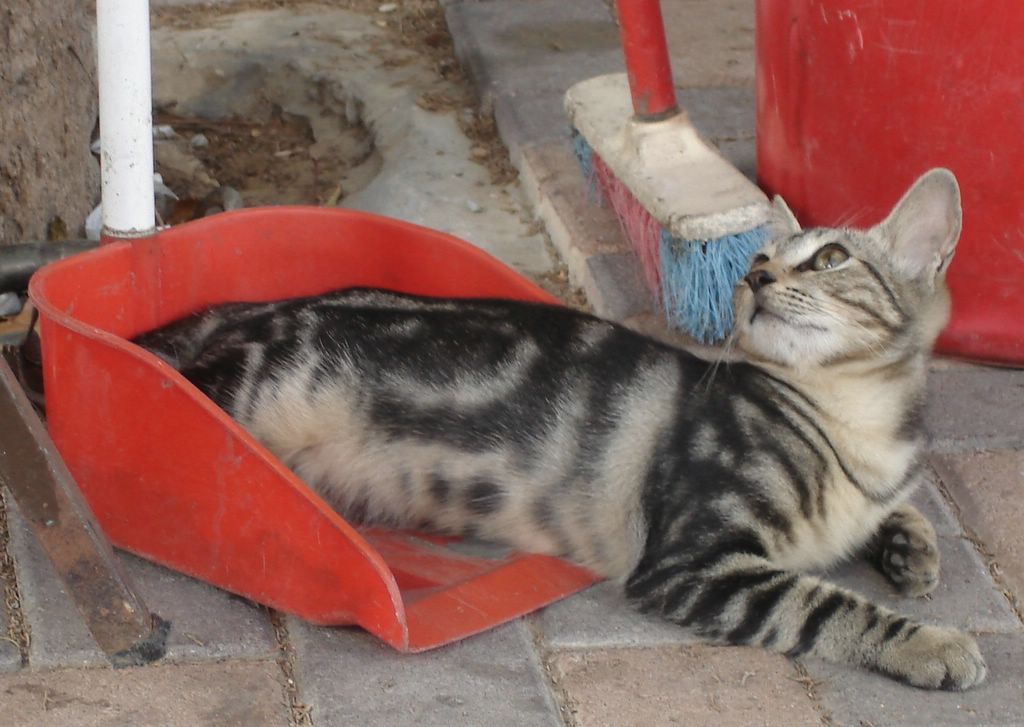
Meet Mitzi. She lives at the Binyamina railway station and is cared for by the cab drivers at the taxi stand there.

Mitzi, the railway station kitten

“You talkin’ to me?”

You talkin’ to me?

Some of these guys are the toughest people you’ll ever meet, but everyone has a soft spot for Mitzi.

Gotcha!

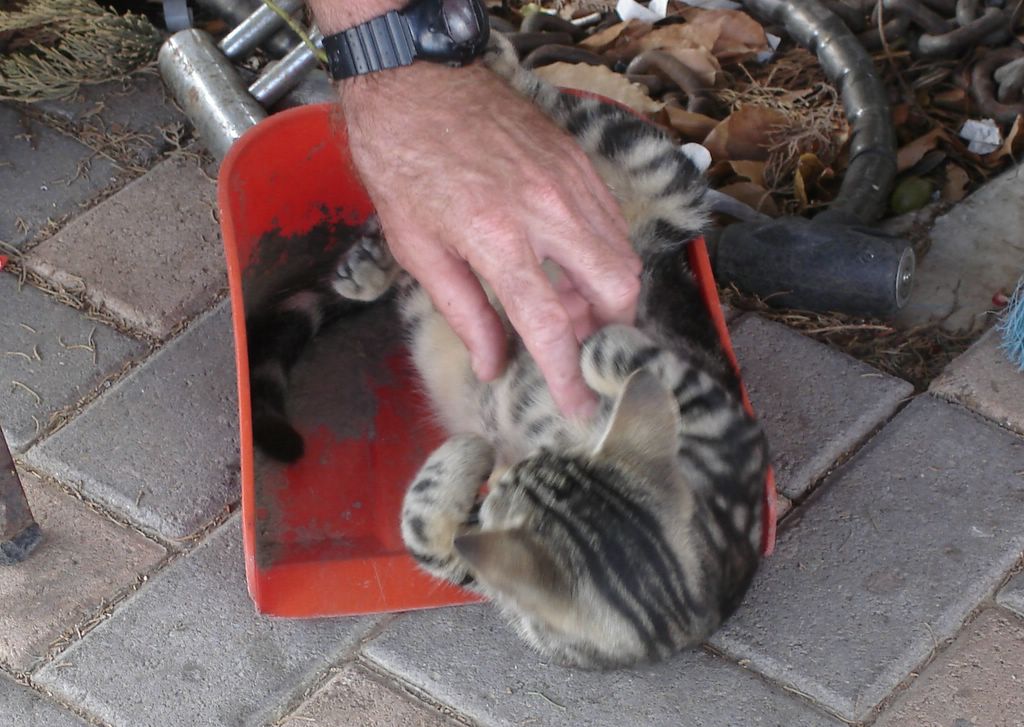
Mitzi likes her bellyrubs. (And her many admirers.)

Mitzi gets a bellyrub

(Catch this week’s Carnival of the Cats at Blog d’Elisson, home of the lovely Hakuna and Matata.)

September 11, 2001: We Remember

The September 11 Digital Archive collects, preserves and presents the history of the September 11, 2001 attacks.

The world changed forever on that day, and we are still at war. We must never forget that.

I Want One, Too

Avi Burstein of Ten Agurot has a parakeet tree right outside his window. Go take a look at his pictures. They’re really something special.

Ark’s Up

Catch this week’s Friday Ark over here.

Going for a Dip

I’m going to a wedding early next week, so yesterday I went looking for a gift. After seeing many choices, I decided on some lovely, delicate teacups with a pattern etched near the rim and a set of wooden coasters to go underneath.

So what’s with the water, you may ask? According to Jewish law, new kitchen utensils made of certain substances (usually metal and glass, but ask your rabbi if you’re really interested) must be dipped in a mikveh (pool of water used for ritual purposes) before use. (You can find out more about the custom and its origins here.)

Long ago, back in the US, I happened to be in the local mikveh dipping a bunch of new kitchen stuff. This particular mikveh had no special place to dip utensils, so those who wanted to dip anything had to go to the actual mikveh, take their shoes off, sit on the top step with their feet in the water and bend over.

So there I was, dipping my few things, when I saw a newly-married couple come in with a cart full of new kitchen utensils, evidently wedding gifts. And while I was happy for them, I couldn’t help but think of what their backs would be like by the time they finished dipping everything in that cart.

And then I thought how much easier things would have been for them if each person had dipped his or her own gift before giving it.

So now that’s what I do. I guess you could call it my own little custom, though I’m sure that other people do it, too.

Funny dipping story: once, long ago in the US, I had some new utensils to dip but couldn’t get the key to the mikveh before Shabbat. So I headed for the local river. I was hard at work when a young man called to me from a nearby boathouse: “If you want to wash your dishes, there’s a sink up here.”

When I explained that I was following a Jewish custom, he replied: “That’s strange. My parents are Israeli, and I never heard of such a thing!”

“Your parents are from Israel? You’re Jewish?” I said. “Good, then you can come down and help me out here. My wrist feels like it’s about to break off.”

So I finished dipping my new utensils—in the middle of nowhere—with the help of that young man. Neat, huh?

Anyway, the teacups are safely dipped.

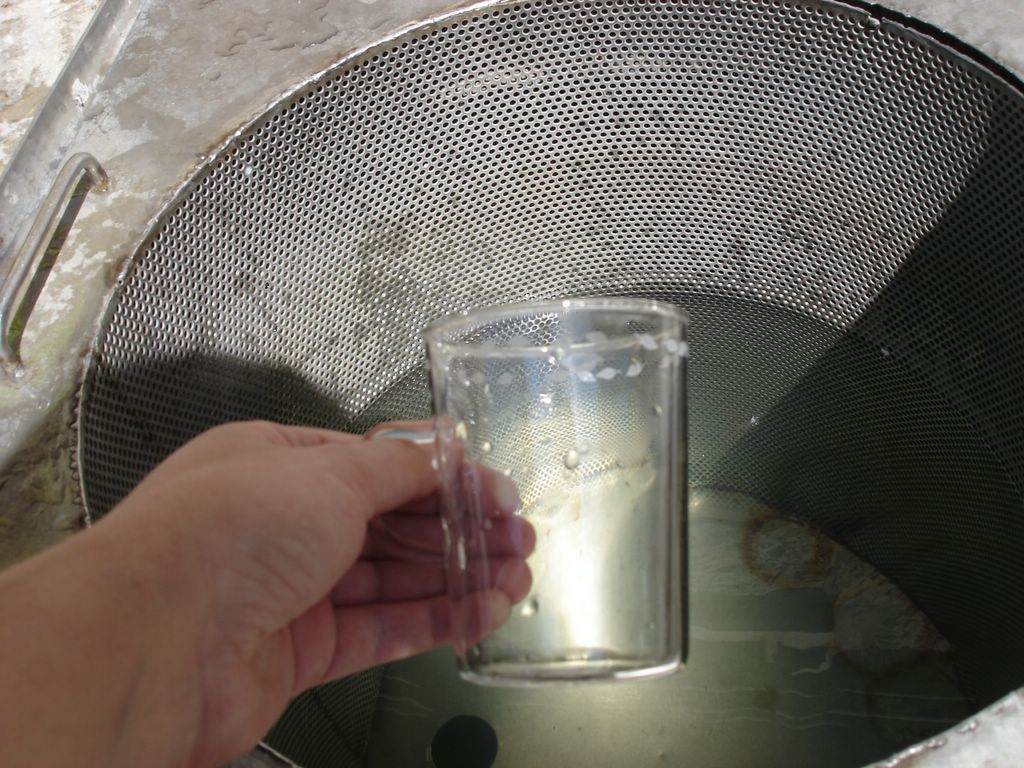
The container of water specifically used for dipping kitchen utensils:

Mikveh for kitchen utensils

One of the cups, between dips (many people dip more than once, just to be sure):

The glass, between dips

The cup in the water:

A few notes: Since the water must touch the entire utensil at the same time, I formed a loop around the cup’s handle with my thumb and forefinger and jiggled my hand a bit to make sure that there would be a point when the cup wasn’t touching my skin. (Some mikva’ot for utensils have a plastic market basket on the premises, which makes things a whole lot easier. Unfortunately, this one didn’t.) Also, in the interests of accuracy, I dipped the cup in the pictures before photographing it.

Some people like to give wedding gifts that make a splash. With mine, the splash has already been made.

Whazzat?

Sometimes I enjoy having a bit of fun with the local version of English.

Restaurant sign

They mean kosher, of course. And la-mehadrin refers to those who keep a stricter level of kashrut, the Jewish dietary laws. See if you can spot the missing letter in “restaurant.”

Elevator sign

Oh, dear. I hope I’m never stranded in this elevator. You see, I have no idea what a “dutton” is or how pressing one could possibly help me in such a situation. Nor do I know how to “whit,” patiently or otherwise.

Saturday, September 10, 2005

Sights for (My) Sore Eyes

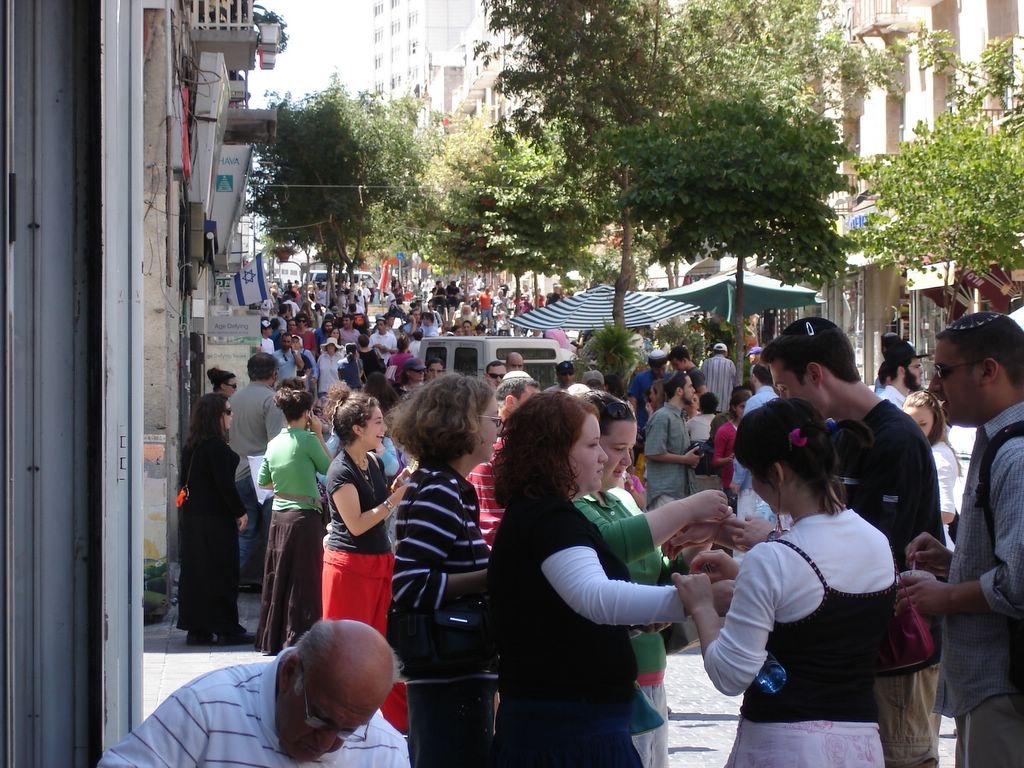
The Ben-Yehuda pedestrian mall, once again filled with people shopping, eating, hanging out and generally having a good time:

Ben-Yehuda pedestrian mall

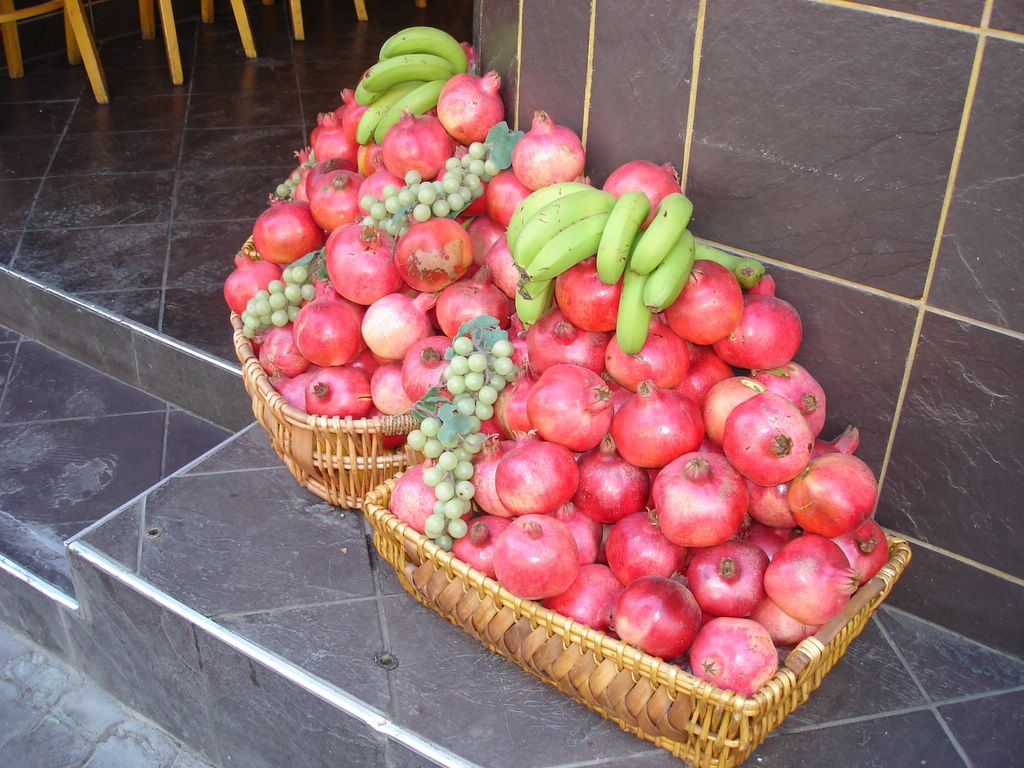
Local produce outside a shop that sells freshly-squeezed fruit juice made to order:

Produce of the land

Boundaries

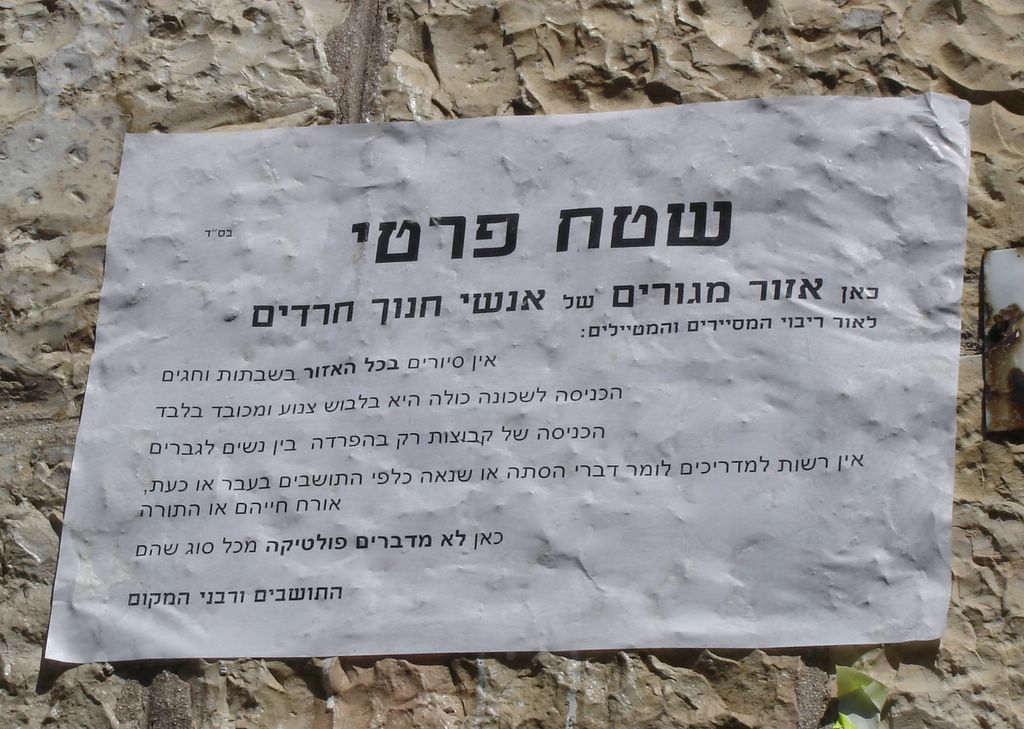
I saw this sign in a neighborhood near the Mahane Yehuda market yesterday:

Sign

Here’s my translation:

Private Area

This is a residential area of haredi [strictly religious/ultra-Orthodox] educators.

In light of the increase in tourists:

No tours are allowed in the entire area on the Sabbath and Jewish holidays.

Entrance to the entire neighborhood is permitted only to those in modest, respectable dress.

Entrance is permitted only to groups in which there is complete separation between men and women.

Tour guides are not permitted to make statements containing incitement or hatred regarding past or present inhabitants, their way of life or the Torah.

No politics of any kind are to be discussed here.

—The residents and rabbis of the neighborhood

A city like Jerusalem usually attracts a large number of tourists (yes, thank goodness, they’re coming back). And there are quite a few neighborhoods here whose way of life differs significantly from what people might consider the standard Western model. (Heck, even I have had tourists from the US treat me as though I should be kept under glass because I live, work and shop in the Holy City—and I’m originally from the US myself!) So I can certainly sympathize with a neighborhood’s desire for peace and quiet, and of course for respect. I’ve been there, too.

From September 1998 until March 2000, I lived in Jerusalem’s Old City as a house-sitter. The apartment in which I lived was located in the Jewish Quarter, a popular tourist destination, and overlooked the Western Wall. One of the friends I made there, a permanent resident of the Jewish Quarter and, if memory serves, a member of its residents’ council, told me of the problems she and her neighbors had with tourists who spoke loudly under their windows at all hours of the night. She wanted very much to remind them, politely of course, that although Jerusalem is a holy city, it is also a city where real people live, work, raise families and, as a consequence of all these, need their sleep.

I particularly remember the incident in which several young yeshiva students, evidently affected by the high level of spirituality that prevails here, felt drawn to sing beautiful religious ballads at the top of their voices in the rear of the Western Wall Plaza at one o’clock in the morning. Esteemed readers, do you know what is located in the slope just behind the Western Wall Plaza? Residential apartments. Dozens of them, all containing people who are usually asleep at that hour. I went downstairs in a modest house-dress (modest enough to be seen outside there, but also house-dressy enough to give the young singers a clear message regarding what time it was) and politely bawled them out, reminding them that gezelat shena (stealing sleep from others) is considered a serious violation of Jewish law.

Anyway, about the sign. I have to admit I was a bit confused by the regulation forbidding tour guides to “make statements containing incitement or hatred regarding past or present inhabitants, their way of life or the Torah.” Exactly what constitutes incitement or hatred in this case? Would this mean, for example, that a tour guide just a kilometer or so away would not be allowed to mention the enmity between the haredi population and Eliezer Ben-Yehuda, who revived the Hebrew language? Unfortunately, this enmity, which was a well-known fact of Jerusalem life in its day, still exists—to the extent that every plaque installed outside Ben-Yehuda’s former residence indicating that he once lived there has been forcibly removed. So the only reason anyone knows where Ben-Yehuda once lived, and why there is no plaque indicating this at the site, is that tour guides tell them so! (One also wonders what juicy stories about “past or present inhabitants” the sign-makers would like to keep from the general public. After all, every neighborhood has its stories, and since some of these places are more than a century old, there must be quite a few by now.)

I agree that no one should have to listen to criticism—even legitimate criticism—of their way of life beneath their very windows. But where does respect end and control begin? I recall, le-havdil (to make a separation), being told by the caretaker at an archaeological site owned by a particular foreign church that outside tour guides are not permitted to speak to groups at their site. When I asked why, the young man eventually explained that these tour guides have an unpleasant habit of describing his church as a missionary organization. Yet that is exactly what it is! So what is to prevent the tour guides from telling this to their groups while they’re on the bus, before or after they arrive?

By the same token, what is to prevent tour guides from making critical statements, or even perpetuating unfortunate stereotypes, about the inhabitants of these neighborhoods before or after they come with their groups? (And yes, regrettably, some do perpetuate such stereotypes. I have direct experience of that.)

If the residents and rabbis of these neighborhoods are so concerned that tour guides might speak critically of them that they have to put up a sign forbidding it, why don’t they train their own guides or meet with the outside guides to discuss their concerns? Surely we know by now that censorship doesn’t work. Silencing critics does not make criticism go away, whether the criticism is justified or not. (Especially here in Israel, where people are not exactly known for their reticence.)

I like the ban on discussing politics, though. I think I may go hang out there when I’ve had my fill of translating news.

Thursday, September 08, 2005

Removing Greenhouses in Atzmona

My friend Dale went down to Atzmona to remove greenhouses before they were to be demolished as part of the disengagement plan. Here is his story.

Today’s Pictures

Catnip seeds forming:

Catnip seeds forming

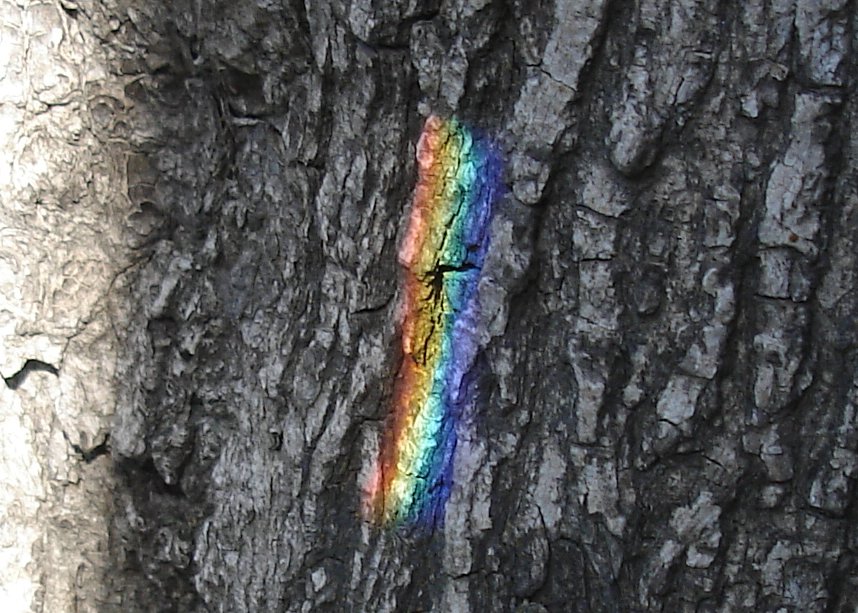
Sunlight on tree bark, through a prism:

Rainbow on tree bark

A Jerusalem parakeet before bedtime:

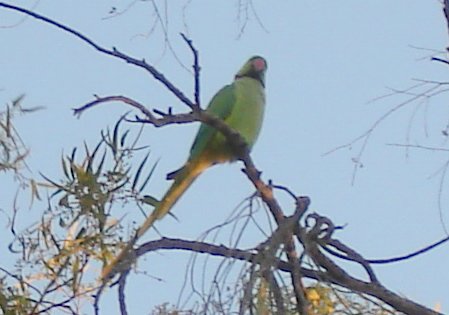
Jerusalem parakeet

Same parakeet, slightly different pose. I almost photographed its mate, but just as I was raising my camera, all the parakeets in the area (some of which I hadn’t seen) took off in unison and flew to a tree farther away, where they bedded down for the night. It was like clockwork: one moment they were out, calling to each other and flying around; the next moment they were gone.

Jerusalem parakeet

They reminded me of some FM stations I remember from the US that went off the air right at sundown. Good night, parakeets. Pleasant dreams.

What Was That?

I heard what sounded like a loud explosion about a half hour ago. Then I heard two sirens a minute or two apart. Then ... nothing.

So whatever it was, it appears to be harmless. Everything’s quiet now, no more sirens, nothing on the news.

Thank God.

(But the question remains: what on earth was it?)

Ouch

So it’s the end of the day and I’m taking pictures of the fennel plant near my workplace on my way home. Here are some fennel seeds that are almost there:

Fennel almost-seeds

These fennel seeds are there. Put ’em in the ground and they’ll sprout once the rains start getting serious (December/January). Or you can make tea out of them, though it’s a lot easier just to buy it in the store.

Fennel seeds

Good so far, right? Well, then I got on the bus, sat down and put my backpack on my lap like I always do. Only this time, something stabbed me in the leg—hard, and with all the weight of my backpack behind it. (It was pretty alarming, actually.) I took a deep breath, lifted up my backpack and found this stuck to the bottom of it:

Thistle blossom gone to seed

For a split second, I thought it was a bug. And I almost screamed. (Thank you, Elisson.) Then I got a closer look and calmed down.

I don’t know why they call it a thistle. They should call it an ouch.