Wednesday, May 04, 2005

Menorah of Courage: A Post for Yom ha-Shoah (Holocaust Martyrs’ and Heroes’ Remembrance Day)

This [God’s promise to Abraham in Genesis 15:13] is what has stood by our ancestors and ourselves. For not just one alone has risen against us to destroy us, but in every generation they rise against us to destroy us; and the Holy One, blessed be He, saves us from their hand.
(from the Passover Haggadah)

There is a famous photograph of a Hanukkah menorah in a window opposite the town hall of Kiel in Germany. The year is 1933, and the building that the menorah faces is decorated with a Nazi flag. The photograph always makes me think of David and Goliath, except that here, David did not dispatch the enemy with one blow. Instead, it was Goliath who attacked—with unparalleled cruelty and viciousness—and David who survived, after bleeding almost to death.

I saw the photograph for the first time in A Different Light, a book about Hanukkah. Soon after I received the book from one of the authors in exchange for a copy of my CD, I read it from beginning to end and discovered the photograph, which made a strong impression on me.

Several months after I received the book, I spent Shabbat with friends of mine in a town near Jerusalem. At lunch, a woman at the table asked: “Has anyone ever seen the menorah at the home of the M. family? It appears in a famous photograph”—and she proceeded to describe the very same picture I had seen in the book. I couldn’t believe my ears. The M. family lived on the same street where I was staying, only a few houses away from my friends’ home.

After Shabbat I went to the M. family’s home and asked to see the menorah. The family graciously allowed me to look at it, touch it and hold it, and they told me its story.

The menorah had belonged to the town rabbi, a direct ancestor of the M. family. At approximately the time the photograph was taken, the rabbi denounced the Nazis from his pulpit. Understanding the danger he was in, his congregants begged him to get out of Germany, and although he resisted at first, in the end they persuaded him. He immigrated to pre-state Palestine together with his family, who brought the menorah with them.

When I got home later that night, I e-mailed the author of the book. “You’ll never believe what I just saw and held,” I wrote. The author put me in touch with an archivist at the Holocaust Museum in Washington, DC, and in turn I put her in touch with the M. family. The story of the menorah and the rabbi who defied the Nazis from his windowsill and from his pulpit is now properly archived in the museum.

Recently the M. family was blessed with a grandchild. As he grows up, he will learn the story of his courageous ancestor and the menorah he brought from darkness to light.

* * * * *

P.S. Here’s an appropriate site for today: the Reunion page at the Yiddish Radio Project. Siegbert Freiberg was separated from his father during the Holocaust. Both father and son miraculously survived and were reunited on the radio program Reunion on July 6, 1947.

Make sure to click on the link at the bottom of the page, “Other Radio Broadcasts about the Holocaust.” And be warned: some of the material makes for difficult listening.


Tuesday, May 03, 2005

Natan Sharansky: Why I Am Quitting Your Government

Natan Sharansky resigned from the cabinet yesterday. The Jerusalem Post has printed his resignation letter.

As you know, I have opposed the disengagement plan from the beginning on the grounds that I believe any concessions in the peace process must be linked to democratic reforms within Palestinian society. Not only does the disengagement plan ignore such reforms, it will in fact weaken the prospects for building a free Palestinian society and at the same time strengthen the forces of terror.
Will our departure from Gaza encourage building a society where freedom of speech is protected, where independent courts protect individual rights, and where free markets enable Palestinians to build an independent economic life beyond government control? Will our departure from Gaza end incitement in the Palestinian media or hate-filled indoctrination in Palestinian schools? Will our departure from Gaza result in the dismantling of terror groups or the dismantling of the refugee camps in which four generations of Palestinians have lived in miserable conditions?
Clearly, the answer to all these questions is no.
The guiding principle behind the disengagement plan is based on the illusion that by leaving Gaza we will leave the problems of Gaza behind us. As the mantra goes, “We will be here, and they will be there.” Once again, we are repeating the mistakes of the past by not understanding that the key to building a stable and lasting peace with our Palestinian neighbors lies in encouraging and supporting their efforts to build a democratic society. Obviously, these changes will surely take time, but Israel is not even linking its departure from Gaza to the initiation of the first steps in this direction.
In my view, the disengagement plan is a tragic mistake that will exacerbate the conflict with the Palestinians, increase terrorism and dim the prospects of forging a genuine peace. Yet what turns this tragic mistake into a missed opportunity of historic proportions is the fact that as a result of changes in the Palestinian leadership and the firm conviction of the leader of the free world that democracy is essential to stability and peace—a conviction that is guiding America’s actions in other places around the world—an unprecedented window of opportunity has opened.

The news of Sharansky’s resignation has saddened many people, myself included. I also can’t help thinking how much better off the country would be if only all our Knesset members had this much integrity.

When Along Came a Camera ...

While I was out walking yesterday evening, I passed by something that looked like a clump of nondescript vegetation hanging from a tree branch. Something about it caught my attention, and on closer inspection it turned out to be the nest of a Palestine Sunbird, with the female bird perched just outside the entrance. I tried to photograph it but the bird flew away, and in any case there wasn’t enough light.

This morning I passed by the nest again. The female was inside this time. Only her head was visible as she scanned the area, alert for intruders.

My camera is a simple one that’s part of a cellphone. It has no flash or zoom. But I really wanted this picture, so I approached as quietly as I could, my hand raised to take the picture. Unfortunately, the female noticed me and took off, chirping in distress as she went.

Here’s a picture of the nest, sans bird.

Palestine Sunbird nest

Meanwhile, the female perched on a nearby branch, chirping and calling. Feeling a bit like Miss Muffet’s spider, I took her picture quickly and left so that she could get back to her nest.

Female Palestine Sunbird, frightened from her nest

Oh, well. Better luck next time.

All Right, Who Turned Back the Clock?

It’s overcast and raining outside, which is not the usual weather pattern for Israel in May. By now we’re supposed to be starting the long, hot, dry season, but outside it looks like someone turned the clock back to March.

Not that I’m complaining, mind you. The thing I miss most about the US is rain in summertime.

But this is just strange.

Saturday, April 30, 2005

What I Did for My Birthday

As my half-dozen readers may have gathered from a recent post, I just had a birthday—a rather significant one, in fact. I confess it: I flipped a digit. Yes, I know that’s a pretty serious thing do to, so I promise to wait ten years before doing it again.

So what did I do to celebrate? A few things.

There’s a wonderful all-you-can-eat meat restaurant downtown called Vaqueiro. It’s a combination South American/South African place. For a fixed price, the smiling, friendly waiters bring out samples of ten different kinds of meat (five if you’re there for lunch), and once you’re done sampling, they’ll bring you as much as you want of whichever kind you request. Once you’re on their database, they’ll send you an invitation for a free dinner on your birthday (and a free bottle of wine on your anniversary).

My friend and I went there a few days before Pessah and had a wonderful time. We were pretty full even before the end, though, and at one point we started laughing when the food just never seemed to end. “What—they’re bringing us more?” we asked each other in disbelief. We could hardly move by the time we left. Moderation? Not that evening!

Another friend took me to Mini-Israel. It was terrific—the models of various buildings throughout the country are exquisite and all the miniature plants are real. There’s even a plant nursery near the entrance where you can buy the same kinds of plants used in the park. (At the Mini-Israel website, click on the link in the upper left corner for the English-language version, and click on the icon of the speaker in the upper right corner to turn off the music.)

We continued my birthday romp with a trip to the new exhibit at David’s Citadel, “Train Tracks to Jerusalem.” It’s a history of the train to Jerusalem from Ottoman times to the present, and highly recommended. (Mind the gap!)

By the way, there are model trains all over Mini-Israel—quite literally—so the train-loving part of me was well nourished. I’m still planning a trip to the Railway Museum in Haifa, though.

(Cross-posted at Israelity)

Saturday Night Catblogging

Her Ladyship must have been muscling in on the Dowager Duchess again:

Her Ladyship and the Duchess in mirror image

The Duchess is the kitty on the right, wearing the blue collar.

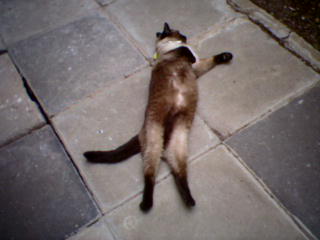
And here’s Her Ladyship in a less-than-dignified pose—or maybe she’s imitating us humans.

Her Ladyship lying on her back

(By the way, Her Ladyship is not asking for a bellyrub when she does that. Trust me on this.)

Check out the Carnival of the Cats at Running Scared this week.

Friday, April 29, 2005

Houston, We Have a Purr (or: What, Me Envy?)

My poetry-writing buddy from Atlanta, Elisson, went on a pilgrimage to Houston this past week, where he met Lair Simon and his four beautiful, noble and charming cats.

Upon his return, Pilgrim Elisson graciously remembered me as follows:

[Rahel, I know this is gonna make you eat your heart out, but I gave them all extra skritches for you.]

Now why on earth would I be jealous? Just because Elisson got to be in the same city, nay, on the same continent as all four of Lair Simon’s wonderful, gorgeous kittycats? Just because he got to pet the colorful Piper, copper-striped polydactyl Nardo, fluffy Frisky and cavekitty Edloe with his own hands? Just because he got to meet Lair in person?

Jealous? Me? Nah. I’m an adult, you see. Mature. I even have proof: tonight, according to the Hebrew calendar, I flip a significant digit. (According to the Gregorian calendar, I flipped it last week.) So—what, me envy?

::sniffle::

Oh, all right, then. Maybe just a little.

Keeping My Hand In

When I woke up this morning, my left hand hurt. A lot.

Well, actually it was the wrist. Specifically, the left side of the wrist. After a day of this, I’ve figured out even more specifically that whatever’s hurting in there is connected to my little finger. I can still do most things without pain, but try to use that little finger and ... well, best cover your ears.

I’ve got to wonder how it happened. My hand was fine when I went to sleep last night, and it’s not like I was out digging ditches while I slept or something. (At least, I don’t think I was. ...)

So typing is not a lot of fun today. Life says: tough luck. I had to go to work this morning, and my job means quite a bit of typing. Ouch.

A dear friend who knows quite a bit about sports injuries told me I must RICE. That’s an acronym that means: rest, ice, compress and elevate above the shoulder as much as possible. (She recommended aspirin too, for its anti-inflammatory effect.) So I’m typing with a bandaged wrist packed in ice. I guess there’s a first for everything.

Like I said: ouch.

Monday, April 25, 2005

Around and About

RIP, Ezer Weizman: The Jerusalem Post remembers former President Ezer Weizman, who passed away last Saturday night at the age of eighty.

Remembering the Rachels: Tom Gross’s answer to the recently produced play in Britain glorifying ISM terror-enabler Rachel Corrie: The Forgotten Rachels.

My Name Is Rachel Thaler is not the title of a play likely to be produced anytime soon in London. Thaler, aged 16, was blown up at a pizzeria in an Israeli shopping mall. She died after an 11-day struggle for life following the February 16, 2002 attack when a suicide bomber approached a crowd of teenagers and blew himself up.
She was a British citizen, born in London, where her grandparents still live. Yet I doubt that anyone at London’s Royal Court Theatre, or most people in the British media, have heard of her. “Not a single British journalist has ever interviewed me or mentioned her death,” her mother, Ginette, told me last week.
Thaler’s parents donated her organs for transplant (helping to save the life of a young Russian man), and grieved quietly. After the accidental killing of Rachel Corrie, by contrast, her parents embarked on a major publicity campaign. They traveled to Ramallah to accept a plaque from Yasser Arafat on behalf of their daughter. They circulated her emails and diary entries to a world media eager to publicize them.
Among those who published extracts from them in 2003 was the influential British leftist daily The Guardian. This in turn inspired a new play, My Name Is Rachel Corrie, which opened this month at the Royal Court Theatre, one of London most prestigious venues. (The New York Times recently described it as “the most important theatre in Europe.”)

A nation unlike all others: Yehuda Avner on the idea of Israel as a nation among other nations:

To begin with, our profoundest oddity is our identity. Many gentiles—and many Jews for that matter—have only the slightest comprehension of what a Jew is. At the salons and receptions where Israeli diplomats move, one might encounter people bemused over why our envoys display as much concern for the welfare of the local Jewish community as they do for their own countrymen. It is not uncommon, for example, to be collared by some vaguely inebriated individual and asked, “Now, tell me, what exactly are you Jews—are you a nation, or a religion, or what?”
The answer—both—is baffling. For, in modern society Jews are unique in personifying a nation-faith personality, a seamless blend of peoplehood and religion born out of the two seminal events that forged our identity: the Exodus from Egypt, when we entered history as a people, and the concomitant giving of the Torah at Sinai, when we entered history as a nation-faith.
Whether one is a believer or a skeptic, this subtle individuality is indivisible. A Jew cannot be one without the other, though many throughout the centuries have tried. A Jew remains forever a synergy of Exodus and Sinai.

Read the whole thing. Hag sameah (happy holiday)!

Friday, April 15, 2005

Stalking the Wild Siamese

This is one of my friend’s two Siamese cats. She is fifteen years old. I call her the Dowager Duchess. (The light is strong in this picture because the Duchess enjoys lying down under an incandescent lamp for warmth.)

The Dowager Duchess

Hold your mouse over the photographs for additional text. (I learned this trick from Meryl.)

This is the Duchess’s housemate, Her Ladyship. She’s about six and very jealous of any attention the Duchess receives.

Put that clickey thing in my face one more time and you’ll regret it.

Here they are together. (I apologize for the smaller photograph; I unwittingly changed the size settings on my cellphone before I took it.) Notice that Her Ladyship is stalking the Duchess, who was in that spot first.

Her Ladyship stalks the Dowager Duchess

The same thing happens at home. “I believe this was my spot,” says Her Ladyship. “Youth hath its privileges, Duchess. Now move.”

Her Ladyship prepares to muscle in on the Duchess

“Didn’t you hear me? I said: Move!”

What part of ‘move’ didn’t you understand?

The Duchess doesn’t have the patience for these power games. She just wants some peace and quiet, and if she has to give a little ground in order to get them, she will.

All right, here’s some of my spot. Now grow up.

Her Ladyship has a weak spot, though. Like all cats, she enjoys getting into a sheltered spot and peeking out at the world from there. In this case, her sheltered spot happens to be underneath my skirt.

Hiding? Who’s hiding?

My legs ache, Your Ladyship. May I stand up now?

Me? Hiding? Ridiculous. I was just sheltering from the sun.

Back inside, the Dowager Duchess is finally free to rest undisturbed.

Finally, some peace and quiet. Thank goodness.

Skritch early and often. Shabbat shalom!

In Every Generation

Jerusalem Post columnist Barbara Sofer on Intifada-denial:

Intifada-denial is a dangerous error. Even for Israelis who enthusiastically supported Oslo and Camp David, four years of violence has forced a reckoning with reality. The pointless murder and savage mutilation of civilians, coupled with the images of celebratory joy by Palestinians as buses were torn to pieces and the Twin Towers crumbled had to be an awakening. Anyone who is concerned about peace in the Middle East would be nuts not to factor in this hatred.

Would that we could turn the clock back to 2000. Let’s imagine what would have happened if the Palestinian people had invested their considerably energy, not in violence but in restructuring the PA by accepting Ehud Barak’s plan at Camp David.
A nascent Palestinian state could have been celebrating its fifth anniversary. Young leadership could have reformed the corrupt mechanisms of government instead of devising plans for recruiting and dispatching teenagers as human bombs. The techies who design tunnels and bomb factories could have been turning out air-conditioners and gas cooking grills, building houses, improving their highway system and designing computer programs.
The billions of euros poured in by the Europeans would have supported these projects, as well as constructing bright new schools, hospitals equipped to treat cancer and prevalent genetic diseases.
But, of course, this is more than a question of wasted opportunities. So many are dead, so many have lifelong disabilities. As a society we have become terror survivors. The term “terror survivor” was actually coined in this “intifada” by a Jerusalem woman named Shoshana Gottleib. She was shot in the spine on the way home from work. Because she’d been bending over to put orange peels in a plastic bag on the floor, she wasn’t killed. The terrorist who shot her for pay later complained that he didn’t get his money because she’d survived.
...
We’re in the midst of preparing for Pessah, the national holiday in which it’s our obligation to pass on to our children the message of the joyous, divine moment of liberation from slavery. I know it kind of throws a damper on the party, but we’re also obliged to remember that in every generation someone tries to destroy us.
Imagine reading those lines of the Haggada at the Pessah Seder at Shoshana Gottleib’s home. The intifada was, indeed, another of these malevolent but futile attempts to destroy us. Would that it weren’t so.

Read it all.

Trains of Thought

Amos Asa-El writes about the Jerusalem train past and present in today’s on-line edition of the Jerusalem Post.

Then:

To us kids, the train’s two-and-a-half hour odyssey to the coastal metropolis at the other end of the railroad seemed all too short. From the picturesque, godforsaken station of Bar Giora to the cement factory outside Ramle through the lovely Nahal Hajora sewage stream, our little noses were glued to the windows, as we did our best to absorb what for us was a cultural experience at least as exhilarating as a combined ticket to the Louvre, the Vatican and the British Museum would have been for our parents.

And now:

Monday morning I entered the newly inaugurated railway station in Malha. Having parked in the spacious lot outside it, and crossed the station’s glistening marble floor almost as awestruck as a worshiper in a cathedral, I bought a roundtrip ticket to the Shalom Center in Tel Aviv, where I had scheduled a meeting.
Carpeted and equipped with little tables, the train cars were nicer than those I remembered from Boston's suburbs. The ride, as smooth and quiet as a sail boat gliding its way across a mirror-flat lake, unveiled the same old vistas, replete with the occasional abandoned British guards’ pillbox, the Bar Giora greenery, and Nahal Hajora’s blackish pourage.
Before long a mobile kiosk manned by a young girl showed up, laden with fresh sandwiches, pastry and beverages. The Boston-New York-Washington trains I frequently took never offered this, I thought, as we swooshed past the Ayalon Freeway’s heavy traffic into Tel Aviv’s newly Manhattanesque skyline.

I rode the train from Jerusalem to Tel Aviv in daylight for the first time last Sunday, and my nose was pressed to the window too, just like the little kids Asa-El describes above. Oh, and here’s that abandoned British pillbox:

Abandoned British pillbox on the Jerusalem-Tel Aviv railroad line

I filled up my cellphone camera’s memory almost completely on that one ride, and I’ll probably be doing it again.

Tuesday, April 12, 2005

Sad News

Ehud Manor, one of Israel’s most important and beloved lyricists and translators, died last night of heart failure. Here are reports from the Jerusalem Post, Ynet and Haaretz.

Allison Kaplan Sommer of An Unsealed Room writes about her connection with Ehud Manor.

I had a bit of contact with him, too. Shortly after I arrived in Israel, he called the office where I was working as a secretary, and I was delighted that I had actually gotten to speak to the man whose work I admired so much. Years later, he graciously played a track from my CD on his radio program. (I didn’t hear it, but a friend of mine did and told me about it later.) I had hoped to work with him someday, even on one small project or one brief program, but unfortunately it never happened. I came close to it once, though.

In 1995, Ehud Manor and Rivka Michaeli co-hosted a live radio program called “What Did We Have There?” The program, which aired for an hour on weekday mornings, featured a segment where Manor and Michaeli played messages that listeners left on the show’s voice mail. Since Purim was approaching, I called the voice mail and sang my Hebrew translation of a feminist Purim song, and to my surprise they played it on the air the following week. Then, to my utter astonishment, they called me at home several days later to tell me how much they had enjoyed it. Because I was shocked speechless, I barely managed to tell Ehud Manor that I had admired his work since childhood.

They gave me the number of the studio and told me I could call the program whenever it was on the air. Unfortunately, it was cancelled several weeks later. I never got the chance.

Everyone I know who knew Ehud Manor agreed that he was a mensch. He will be sorely missed.

Help Omri Raziel

Imshin gives important information to those of us who live in Israel about tomorrow’s bone-marrow testing drive to help little Omri Raziel, who has been stricken with a particularly virulent form of cancer.

As Imshin points out, Omri’s family needs financial contributions too because the testing is very expensive.

For those who wish to daven, please daven for Omri ben Sigal. (If anyone has additional information regarding the proper names, please e-mail me.)

Monday, April 11, 2005

Of Past Professors and Poetry

The double dactyl, a fun and demanding poetic form, was invented by Anthony Hecht and Paul Pascal. Anthony Hecht later published a book of double dactyls together with fellow poet John Hollander.

Why am I talking about poets and double dactyls all of a sudden? you may ask.

Twenty years ago Anthony Hecht was my writing professor at the University of Rochester. I just found out that he passed away in October 2004 at the age of eighty-one. I never saw him again after his writing course ended, but I thought of him often and I’m sad that he’s gone. Barukh dayyan emet.

I felt a bit intimidated by Professor Hecht (as I still think of him even twenty years later)—he was, after all, one of the “big guns” in contemporary American poetry—but I used to love to hear him read aloud. He had a gorgeous, deep voice, and I can still hear him quoting from an ancient Greek tragedy in the perfect diction that held just a hint of his Brooklyn roots: “The best of all fates is never to have been born. ...” He had a fine wit and enjoyed challenging his students. I was delighted when I responded successfully to one of his challenges and managed to raise my grade a little at the same time. Heaven knows I needed the boost. Prof. Hecht was a tough grader.

His final exam was a bit unusual. At the beginning of the semester, Prof. Hecht gave us a list of poems to memorize, saying that if we wanted to write good poetry, we must have good poetry already in our minds. (With all respect to Prof. Hecht, in hindsight I am not sure this test was fair. I was lucky because memorization is easy for me, but I remember one student who was, and probably still is, very knowledgeable and an excellent writer but had difficulty memorizing text.) Since I memorize more easily by ear than by sight, I prepared for the exam by reading all the poems on the list into a tape recorder and playing the recording in my dorm room at regular intervals. In the end I did reasonably well, though I still felt a bit intimidated by Prof. Hecht, who was at one point the Poet Laureate Consultant in Poetry to the Library of Congress—in other words, the Poet Laureate of the United States.

It’s been a long time since I had much to do with poetry. But today I happened to be browsing Elisson’s blog and found the poetry he has been writing for National Poetry Writing Month. (If you haven’t visited Elisson’s blog yet, go there. He is an excellent writer and his poetry is fantastic. Funny, too.) Feeling a bit nostalgic for my former writing professor and also feeling a bit impish, I suggested that Elisson try a double dactyl. (That was unfair, I admit, since I’ve never written one myself.) Elisson responded by sending me a link to the double dactyls he has already written. I responded by pointing out pedantically that while the poems may be double dactyls in a technical sense, they don’t conform to the specifications set by Hecht, Pascal and Hollander.

So Elisson of the abundant poetic gifts and sparkling intellect promptly blew me away by writing one that did. Especially for me. By his kind permission, I include it here:

Yiddeldy fiddeldy,
Raheleh Jaskow, she
Skritches those kittycats
Each chance she get.
Cats in Jerusalem
Are not enough for her.
Ailurophiliac’s
Surfing the ’Net!

Wow! I think this is the first time anyone has ever written a poem for me. And me with a birthday coming up, too! (And a pretty significant one at that.) Thanks, Steve!

And thank you, too, Professor Hecht. Rest in peace.

UPDATE: I just wrote my first double dactyl today, inspired by and in honor of Ellison. Here it is:

Kittery cattery,
Steve of Blog d’Elisson
Writes double dactyls with
Sparkle and will.
Humor aforethought, he
Self-deprecatingly
Blows us away with his
Consummate skill.

(I even included an indirect allusion to his beautiful cats, Hakuna and Matata, in the first line. Just so they won’t be jealous.)

My first double dactyl. I hope it gives Professor Hecht a chuckle, wherever he is.

Sunday, April 10, 2005

Music, Music, Music

Israel has a thriving folk-music community with folk clubs that meet regularly in Karmiel, Tel Aviv, Jerusalem, Kibbutz Tzora (next door to Beit Shemesh) and, most recently, the south. If you like folk music, you’ll enjoy them all, and even if the folk genre is not your musical cup of tea, you’ll still enjoy the excellent musicianship and wonderful atmosphere.

The largest Israeli folk-music site is probably that of the Kibbutz Tzora Folk Club, which is lovingly maintained by Judy and Lynn Lewis. Their site includes a gallery of past and present performers from all over the world, including Israel. (Not all of us are expats, believe it or not!)

Although some of the various folk clubs have been in existence for close to twenty years, it has only been in the past five or so that members of the Israeli folk community have begun releasing their own CDs. (Names that come to mind right away include Ray Scudero, Sandy Cash and Jill Rogoff.) This is mainly due to two factors: the increased availability of high-quality recording technology together with the enormous distribution potential of the Internet. Most of us expat musicians sell our CDs at CD Baby, a wonderful on-line CD store located in Oregon.

And speaking of the Internet, this week several tracks from “Poor Working Slob,” an excellent CD of original music by my dear friends Joanna and Ray Scudero, are featured on Rich O’Brien’s Songwriters Internet Radio Show. Their segment is about two thirds in, but the entire show is worth hearing. Rich showcases three of my favorite songs by Ray: “Voyager,” a lyrical picture of the wooden gaff-rigged schooner on which his sister and brother-in-law live and travel the world; “Poor Working Slob,” a witty and affectionate look through a native New Yorker’s eyes at the people who live and work in New York City; and “Horizon Dawn,” a song about taking stock of one’s life.

So ... like music? Pull up a chair, lean back, relax and enjoy.

(Cross-posted on Israelity)

Maiden Voyage (or, I Think I Can)

Tonight I took the inaugural train of the new/old line from Beit Shemesh to Jerusalem. Was it exciting? Absolutely! Here’s a pictorial account of my trip.

The train, which started its run in Haifa at 8:50 p.m., arrives at the Beit Shemesh station at 10:07 p.m. (From Haifa to Beit Shemesh in under an hour and twenty minutes—not bad at all.)

The train arrives at the Beit Shemesh station

All aboard! I hug my friend goodbye and head toward the train.

All aboard!

The Beit Shemesh station from just inside the door of the train.

The Beit Shemesh station, taken from inside the train

On a walk through the train, I discovered that the engineer’s compartment was open. Several media correspondents were there, and the security guard let all of us in. The engineer’s name was Moshe, and he said he was very happy to be driving the train on its maiden voyage. (I apologize for the darkness of the photograph. I also hope to get pictures of the train’s breathtakingly beautiful route in daylight.)

The engineer’s cab by night

A view of the tracks from the engineer’s compartment as we approach the Malha station.

The view from the engineer's cab as we approach the Malha station

One of the Malha station signs.

Malha station sign

The train is temporarily parked on the tracks. Moshe, the engineer, is up ahead, about to get back on the train to drive it to Lod, where it will spend the night.

In Malha. Up ahead is Moshe, the engineer

The train leaves the station for the night.

Heading to park for the night

According to the man from Israel Railways with whom I spoke briefly, the train we traveled on was originally Swedish, and Israel Railways bought it used. Some of the cars still contain the original seats. This man was so up on his train models that he was even able to tell me the train’s original Swedish serial number. For train buffs, here is information on the rolling stock that Israel Railways uses. Most of the information is in Hebrew, but there is enough English to figure out quite a bit.

We traveled in an IC-3, one of the few models that can handle the hills leading to Jerusalem. “We could use other models,” the man from Israel Railways told me, “but then we’d need to use two locomotives up in front, what’s called a double-head. Unfortunately, we can’t use the double-decker model at all. It’s too heavy.”

Our train had nine cars. The average number is twelve, and the maximum permitted number for our particular model is fifteen.

The sparkling new Malha station ...

The interior of the Malha station

... and I’m almost home. Here’s the bus!

The bus home

Gotta go—the driver’s waiting. Good night and shavua tov (have a good week)!

(Cross-posted at Israelity)

Tuesday, April 05, 2005

Juiced Up

Grape juice is not an ordinary drink among religious Jews. Because of the sacramental significance of wine, all grape products, including vinegar and grape juice, are subject to special religious restrictions in order to be considered kosher. As a further indication of its special status, grape juice is not placed together with the other fruit juices on Israeli supermarket shelves. Instead, it is sold in the wine section.

When it comes to making kiddush on Shabbat and festivals, grape juice (as opposed to wine) is popular among families with young children, though plenty of adults prefer it too. There is quite a large market for the organic variety produced by Kibbutz Sde Eliyahu. There is also a cultural divide. My English-speaking friends drink grape juice gladly on Shabbat, while some older Hebrew-speaking friends of mine with roots in Eastern Europe were a bit surprised and amused when I brought them a bottle for Shabbat lunch. Grape juice? they chuckled. What, do you think we’re little kids?

Oops.

For years, the Carmel Winery has produced and sold two kinds of grape juice: red and white. Now they’ve expanded their line to include grape juice made from Merlot and Cabernet Sauvignon grapes, giving a classier dimension to a classic drink.

Fancy grape juice

The bottle on the left, with the red label, is Merlot. The one on the right, with the blue label (it looks purple in the picture), is Cabernet Sauvignon.

Hey, who said grape juice has to be boring? I can’t wait to try ’em.

Le-hayyim!

(Cross-posted on Israelity)

Thursday, March 31, 2005

At Last: The Lady in Red

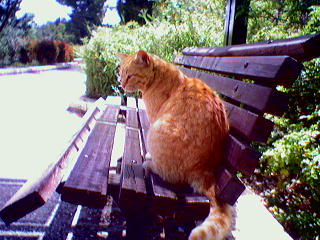
Now that I’m finally able to take digital pictures and post them to my blog, I’d like to introduce my readers to a very special cat. I don’t know her name or even if she has one, so I call her the Lady in Red.

Meet the Lady in Red

For close to a decade if not more, the Lady in Red has been living at a local nursing home adjacent to one of the most beautiful parks in the city. She is well cared for and I believe she’s spayed because I have never seen her with kittens.

Whenever I walk through the park, I usually see the Lady in Red sitting on a bench next to an elderly person or near an adult with a child. She doesn’t demand attention or beg for food. She just sits quietly, offering her good energy to the world.

The Lady in Red waits for visitors

Sometimes she enjoys playing Hide and Seek.

The Lady in Red plays Hide and Seek

The Lady in Red and I have known each other for years. I look for her whenever I walk through the park, and it’s always a treat for both of us when she’s around.

Would you like some skritches, Lady in Red?

Kittyworship for the Lady in Red. Notice the black whiskers on the right side of her face

The Lady in Red enjoys a skritch

Ah, I thought you might.

Sometimes the Lady accepts a drink of water from my hand. Like I said, she is well cared for, but in Israel’s dry climate it is always good to offer water. The Lady purrs as she takes a drink.

The Lady in Red drinks water out of my hand

Once the Lady has drunk her fill, it’s time to wash.

Bath time

Satisfied that she is spotlessly clean, the Lady surveys her kingdom, looking much like her cousin, the lioness.

The Lady surveys her kingdom

The most striking incident in my friendship with the Lady in Red occurred about a year and a half ago, a few days after one of my closest friends died suddenly of a heart attack. Although a light, misting rain was falling, I decided to go to the park to be with my thoughts in nature. As I stood in the park I suddenly heard a loud meow at my feet, and I looked down to find the Lady in Red looking up at me in unmistakable command as if to say Sit down, please. I found a concrete bench that was miraculously not soaking wet, and the Lady in Red did something she had never done in all the years I have known her: she jumped onto my lap and stayed there as the rain fell. The rain didn’t faze her at all, and she made it clear that she would stay with me as long as I wanted her to. I hunched over her to protect her from the rain as long as possible, and when I felt the tips of her fur starting to get wet I said goodbye and left.

Like I said, the Lady in Red is a very special cat.

And being a cat is hard work. Time for a nap.

Time for a nap

P. S. Check out the Carnival of the Cats, this week at CathColl.net.

P. P. S. Thank you, Imshin.

Wednesday, March 30, 2005

Still Blah

I always say I’m too busy to be sick, but apparently my body believes otherwise.

I’m told that some pretty nasty bugs have been making the rounds over here, so I’m not sure whether this is a homegrown bug or something that stowed away with me when I came back from the States. Either way, my voice is just about gone, my head feels like it has a mattress wrapped around it and I’m probably a one-person germ factory by now. I figured it was time to call the doctor and say: This isn’t working; can we try another option, please?

So I called for an appointment only to discover that both my doctor and her partner are at a conference all day today. Which probably means that most of the other physicians who deal with this sort of thing are there, too.

Sigh.

Well, they’re entitled, and anything that improves the quality of medical service is a good thing. So I can’t complain. Not too loudly, anyway.

So my appointment’s tomorrow. In the meantime, I’m missing work, which I actually don’t enjoy doing. But my co-workers really don’t need someone around who sounds like a rusty hinge, has a sore throat and swollen neck making her irritable, can’t focus too well just now and has a germ output that’s likely off the charts.

Come to think of it, I don’t either. I think I’ll go back to bed.

Monday, March 28, 2005

The Blues

Woke up this morning feeling pretty blah. The doctor diagnosed an acute upper respiratory infection. Phooey. What’s so cute about that? (Sorry—couldn’t resist.)

On the way from the doctor’s office to the pharmacy and then home (fortunately they are all within walking distance of each other), I saw a bunch of scarlet pimpernels and took some pictures of them with my new toy, a cellular phone with a digital camera. Here’s one that came out pretty well:

Scarlet Pimpernels

Yeah, I know. If I want to take this seriously I need to get a better camera, one that zooms. One day.

So here’s one of my mistakes—a pretty traditional one, thumb in the lens—but you have to admit that the subject matter makes it worthwhile:

Kittycat with Thumb

Ah, kittycats.

Sunday, March 27, 2005

Waiting in the Wings

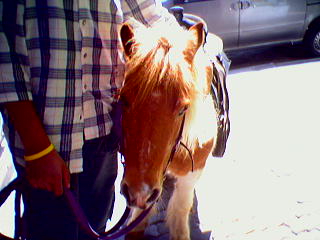
In honor of Purim, there were plenty of events on the downtown pedestrian mall today: clowns on stilts, dancers and singers, jugglers, you name it. But a surprise waited in the smaller alleyways leading onto the mall: three ponies who came, together with their people, all the way from a farm in the Sharon region, about an hour’s drive north of Jerusalem. When I met them, they were waiting for police permission to enter the main area.

Pony Waiting to Enter Pedestrian Mall

Ponies for Purim

Can We Go In Yet?

I’m sure they eventually got their entry clearance. How long could anyone resist these sweet ponies?

The Eucalyptus that Won’t Quit

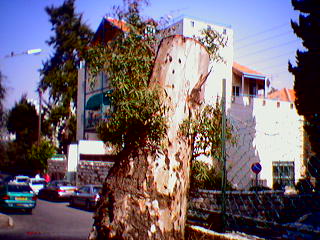
Near my apartment building is a eucalyptus tree that’s been through it all but is still kicking. This tree can give some valuable lessons about surviving during challenging times. Though its top is shorn off and its bark is shaven, it still produces branches and leaves every spring.

Still Alive and Green Despite It All

Another extraordinary thing about this tree is that for years it has been home to a family of large bees, likely carpenter bees (though I’m not sure). In order to drive the bees away, the bark of the tree was shaved off, exposing the tunnels the bees dug to house their eggs.

Bee Tunnels

In past years, when I’ve investigated the tunnels—some of which are as thick as my thumb—I’ve been buzzed by a bee that came out of nowhere to guard her former home, but never stung. According to those in the know, bumblebees are peaceful and rarely sting. But then, these may be carpenter bees. The next time I see one over there, I’m going to have to get a look at its underside.

(Just in case you were wondering, Israel grows bumblebees. I don’t think we grow carpenter bees, though. At least, not on purpose.)

Purpletrees

All right, so the photograph is a bit blurry. But you get the picture: these are some of the jacaranda trees we have downtown, which a knowledgeable friend of mine likes to call by the whimsical name “Purpletrees.”

Jacaranda trees in downtown Jerusalem

(I’ll try to get some better pictures of them soon. I’m still pretty new at this digital photography thing.)

Friday, March 25, 2005

The Train, Boss! The Train!

Wonderful news: after a seven-year break, Jerusalem is about to get train service again. This train is the slower of two lines we’ll be getting and will take approximately 73 minutes to reach Tel Aviv, going through Beit Shemesh and other places. (The speed is slower is because this particular line uses the old Ottoman rail route, which is so full of curves that the trains cannot travel along it safely at full speed. There were many jokes about just how slow the old service was, one of which was that a passenger could leave the train during the trip in order to pick wildflowers and then re-board the train with no problem. In 2008 there will be a faster train from Jerusalem to Tel Aviv, which will take approximately half an hour to arrive.)

Here are two sites for more information: Jerusalemrail.org and Railnewsil.com.

This new service is a far cry from what there used to be (see Imshin’s post at Israelity for more details). Israel’s trains are clean, run on time and are just plain delightful.

(I must admit to a certain amount of bias. I happen to like trains. A lot. I’m especially fond of the New York subway system, which I rode quite a bit these past two weeks when I got to travel to the United States for the first time since I moved to Israel thirteen years ago. Also, when a good friend asked me what I’d like to do for a fairly significant birthday I have coming up next month, my answer was: a trip to the Israel Train Museum in Haifa. I kid you not.)

Seeing that it’s almost Shabbat, I’ll have to post about my trip to the States another time. For now, I think I’ll start making plans to ride the Jerusalem train on Saturday night, April 9, when it goes into service for the first time. Yesh!

What? I can hear readers asking. Ride the train to Tel Aviv and back just for fun? And when the bus takes so much less time?

Well, um, yes. Did I happen to mention I like trains?

(Cross-posted on Israelity)

Monday, March 07, 2005

Hello, Elijah Speaking

I refer, of course, to the biblical prophet Elijah, one of the major figures in the Book of Kings. He was renowned for his fierce stand against idol worship and his dramatic ascent to heaven in a chariot of fire.

But Elijah also has a gentler side. According to Jewish tradition, he is present at every circumcision. He visits every Jewish home toward the end of the Passover seder to take a sip of wine or grape juice from the special cup each household lovingly sets aside for him. And every Saturday night Jews sing a hymn asking that he appear to announce the arrival of the Messiah, heralding a time of peace and tranquility the like of which we have never seen on earth.

In Jewish folklore, Elijah the Prophet is a kind of Jewish Superman. (Or perhaps Superman is the American Elijah?) He is the one who steps in at the last possible moment, when the situation is desperate and there seems to be no way out. No task is too great for him, no method too dangerous, if it means saving the life or livelihood of a person in trouble. According to one story, Elijah once appeared in the guise of a prostitute in order to rescue an innocent man fleeing capture. In another, he built a palace by himself overnight in order to save the livelihood of a poor man. Elijah is also learned in all the secrets of the cosmos, though only a privileged few merit to study them together with the immortal prophet.

In every generation, including this one, people have their own stories to tell about meeting Elijah. All these stories have one thing in common: when things are at their worst, Elijah the Prophet appears to save the situation, giving people the encouragement they need to go on or just doing something nice for someone who could use a favor.

Does Elijah the Prophet really spend his time roaming the earth, seeking out people who need help? I don’t know. But I believe that Elijah is potentially every one of us. To put it another way, perhaps every human being is endowed with a spark of Elijah’s essence. At some point in our lives, someone may need help just when we happen to be able to provide it. And as soon as we take up the challenge we become Elijah, if only for a brief moment. That’s what I think, anyway.

Here’s an example. About fifteen years ago a newly observant friend of mine was in a bookstore in a small Israeli town. He wanted to buy a prayer book but was a bit short of cash. Another man who did not know my friend at all happened to be in the store just then and overheard the conversation between my friend and the proprietor. He rushed over to the counter, plunked down the remaining amount and dashed out of the bookstore before my friend could thank him. My friend was convinced that this man was Elijah. I agree.

Then there’s what happened to a close friend of mine just a few weeks ago. This extraordinary woman has been caring for her seriously ill husband for more than a year and a half. Unfortunately, during this time their financial situation has become quite challenging, to put it mildly.

Early one morning, my friend’s doorbell rang. Since she was busy taking care of her husband, she couldn’t answer right away. When she opened the door a short while later, she found a plastic bag tied to the screen-door latch containing hot, fresh bread and an unmarked envelope. The envelope contained a generous donation for my friend and her husband. There was nothing else, no note of explanation. Just the bread and the envelope.

As my astonished friend stood holding the bag, her phone rang. On the other end was a woman whose voice she didn’t recognize.

“Are you home?” the woman asked.

“Yes,” my friend replied, perplexed. “Who is this?”

“We left a bag on your door,” the woman said. “Did you find it?”

“Yes, but who is this?” my friend persisted.

“That’s not important,” the woman answered.

“Please, I would really like to be able to thank you properly,” my friend said.

“No, no, it’s really not important,” the woman said. “I just wanted to make sure you received the bag.”

“But I want to thank you,” my friend said. “Please, won’t you tell me who you are?”

“Friends,” the woman answered. “We just want to help. All the best to you.”

And with that, Elijah said goodbye and hung up.

(Cross-posted on Israelity)

Wednesday, March 02, 2005

Good News for the Cats of Katzrin

The cats of Katzrin have a new lease on life thanks to The Cat Welfare Society of Israel.

The Veterinarian Service Department and the City Council in Katzrin announced that there will be no use of any poison against cats in Katzrin and withdrew their intentions to use poison, as was previously expressed in their first announcement to the public and to the media. This decision came as a result of the petition that was served by the Cat Welfare Society of Israel at the Magistrates Court of Nazareth against the Katzrin City Council following the discovery of a rabid dog in the area. Instead of mass poisoning, the authorities will engage in steady activities of vaccinating and neutering/spaying of all cats in Katzrin.

My hat is off to the members of this extraordinary group and to performing songwriter Yehuda Poliker, who will be giving a concert to benefit Israel’s street cats and raise awareness of the problem.

(I saw a television program about Yehuda Poliker several years ago. At one point the camera focused on one of his cats, who was sitting on the floor beneath a table in his recording studio. Although no one was touching the cat, its eyes were closed in what looked like utter contentment, it was kneading with its paws and I could see its body vibrating with the force of its purr. I remember thinking: Wow. There must be some really good energy in that studio. I sure wouldn’t mind singing there.)

If you’re fond of cats, scroll down to the bottom of Yehuda Poliker’s page. This one’s a beauty.

And catch the concert if you can. Yehuda Poliker is an amazing performer, and it’s for a good cause.

(Cross-posted at Israelity.)

Sunday, February 27, 2005

Lifting Our Voices

Local singer-songwriter Sandy Cash expresses my own feelings on disengagement far better than I can myself.

I fear for my country. It’s not just the tragedy of “disengagement”—the recent adoption of a policy that calls for the total destruction of 25 Jewish communities. It's not even the fact that there’s no guarantee that this enormous sacrifice, far from having a positive effect on Israeli security, is expected to put more Israeli population centers within striking distance of Palestinian missiles.
No. What scares me is that this entire retreat process is being shoved down the country's throat without any real discussion.

She posted this article on her Israel Diary several days ago, and it is well worth a read. Especially now, unfortunately.

Friday, February 25, 2005

Bone Marrow Donors Needed

From the FolkDJ-L mailing list (posted with permission):

Dear Friends of PeterPaul & Mary who have been so kind and concerned about Mary:
As you are probably aware, Mary has been battling leukemia and we had hoped that the cancer’s remission would sustain. However, recently the cancer returned and therefore she has been admitted to a New York-based hospital for further treatment.
Notwithstanding this new unwelcome challenge Mary’s spirits are strong, her humor intact, and her determination to beat the cancer undiminished.
At this point her doctors are investigating the possibility of a bone marrow transplant and so we are reaching out to all of her many friends around the world to see if you might be generous enough to consider registering as a potential bone marrow donor. Your bone marrow might be a fit for Mary and if not you might be able do a great service for others who similarly need a transplant.
The National Marrow Donor Program offers the test to determine your blood and bone marrow specifics for free and can be contacted through Tel. 800-627-7692; an online form at the National Marrow Donor Program website; or mail to
National Marrow Donor Program
Suite 500
3001 Broadway Street Northeast
Minneapolis MN 55413-1753

Refuah shleimah, Mary.

Wednesday, February 23, 2005

A New Blog in Town

Israel21c has a blog! It’s a group effort with some familiar faces (well, virtual ones, anyway) from the Israeli blog scene.

I found the site through Imshin, whose item on riding the train in Israel is right on track (pun intended). I confess I have fallen in love with the Israeli train system and am ecstatic about the return of the Jerusalem train. (Actually, there will be two lines, but the faster one isn’t due for another three years or so. The slower line—via Beit Shemesh, with a travel time of approximately 73 minutes—is due to begin operation in about a month.) Like Imshin, I remember the old train ride from Jerusalem to Haifa and I didn’t like it much either, for all the reasons she describes (even if the views were stunning). But as she writes, train service here is much better now.

In recent months I have been on trains where employees actually walked through the cars, counting the number of passengers on little hand-held gadgets that clicked every time they pressed a button. At first it felt a little strange being counted like that, but then I was glad. The more passengers, the more trains.

Oh, right. I was blogging about Israelity ... but I guess I got sidetracked.

Heh.

It’s a ... Bird!

The first time I saw a Palestine sunbird, I thought it was a hummingbird. But despite its small size, it isn’t.

The males have gorgeous, iridescent coloring. The females are plain and brown, a bit like sparrows.

Last Shabbat, as I passed by an almond tree in full flower, I saw two Palestine sunbird couples flitting from blossom to blossom, chirping as they went. I could almost imagine that they were saying, “Hey, check out this one! Good nectar over on this side!”

I named them Fred and Wilma and Barney and Betty. They weren’t impressed.

A few months ago, I saw another Palestine sunbird couple outside a friend’s apartment building. The two birds were chittering loudly and I got the feeling that they were in some distress.

I wasn’t wrong. A few moments later I discovered a small orange cat lurking in the bushes just below them. He didn’t look too pleased to have his cover blown.

Palestine sunbirds are among my favorite birds. They’re absolutely beautiful and seeing one always gives a lift to my day. (Pssst ... wanna see one in action? C’mon over here.)

Tuesday, February 15, 2005

Slow Day

Today I finished making six eye pillows before heading to the shuk to buy more flaxseed to fill them ... and if I’m writing that up on my blog, you can bet that today was a slow day. And I really should be translating (at home, not at work).

In fact, I’ve been so preoccupied with work this week that I forgot to mention that this past weekend I spent a sweet and relaxing Shabbat at the home of David and Zahava of Treppenwitz. It was wonderful.

I have to confess that I always feel a little nervous the first time I stay at someone’s home over Shabbat. It has nothing to do with the people involved; I’m just a type that likes to sleep in my own bed. But any nervousness I may have felt was dispelled during the pleasant ride with David and Zahava. Almost as soon as we arrived at their beautiful home, they put on Mary Poppins for their little son Yonah. The tape happened to be in the middle of the film, so among the first things I heard in their home was Dick Van Dyke as Bert, singing: “On the rooftops of London:/Cor, what a sight!”

That was it. That’s my very favorite part of one of my very favorite films, and that was the moment I knew I’d come to the right place. And then there was the breathtaking view from the window of the guest bedroom, which made such an impression on me that I was almost reluctant to go to sleep. I could have gazed at it all night. Best of all was the pleasure of hanging out and shmoozing with David and Zahava, and meeting their older children, Gilad and Ariella, who sparkle—I don’t know how else to describe it. I even fell in love with their sweet-natured black Lab, Jordan.

I keep saying that I think the Internet is a modern-day miracle. Of course, as with anything else in life we have free choice as to how to use it—and if we use it correctly, we can do so much good in the world. Yet in my opinion the Internet’s most miraculous feature is its ability to connect people, both old friends and new. So blessed be the Creator for the miracle of the Internet—and, through that miracle, for the gift of my new friendship with the Treppenwitzes!

(Bogners, Rahel. Bogners.)

Monday, February 14, 2005

It’s Lighter Later

This is my favorite time of year in Israel. The days are getting longer, the flowers and herbs are sprouting and it’s mostly pleasant outdoors.

This afternoon I looked out the window and saw that it was still bright at 5 p.m. Every year at about this time I look forward to seeing the sun at that hour.

I just hope that the cold snaps are over, or that if we get another one, it will at least compensate us with some snow that sticks.

(Hey, I can dream, can’t I?)

Whom Do They Think They’re Kidding?

The riots in the northern village of Mughar this past weekend were sparked by rumors that Christian youths had pasted pornographic photographs of local Druze women on the Internet. Yesterday’s printed edition of Ma’ariv had two brief opinion pieces on the rioting. One, by a Druze public figure whose name currently escapes me, condemned the violence but at the same time pleaded with readers to understand the special Arab attitude toward women’s honor. The other, written by Zoheir Andreus, the editor of the Arab newspaper Kul al-Arab, was all too predictable: it blamed the Jews.

Regarding the former: come off it, Mr. Druze Public Figure; whom do you think you’re kidding? In Arab culture, women’s honor has nothing to do with the women themselves. It is merely a reflection of the honor of the men. If a woman has sexual relations out of wedlock or is unlucky enough to be raped, her entire family is disgraced and is often pressured to kill her in order to cleanse the stain on their honor. In some cases the wearing of a miniskirt and makeup is enough to draw a death sentence. The grim task of execution is often given to a minor because he will receive a lighter punishment, after which he will be able to return to his family as a free man. Rather a bizarre way of demonstrating respect for the honor of women, don’t you think?

We know that honor killings are the dirty little secret of Arab culture. Like spousal or child abuse in western countries, everyone knows it goes on but no one likes to talk about it. A few months ago Israeli Arab members of the Knesset were guests on a political television program. The topic was the phenomenon of Arab men pretending to be Jewish in order to pick up Jewish women whom they took back to their villages and married, sometimes without letting the women know that they already had wives. Every time the program host tried to speak, the Israeli Arab MKs methodically shouted him down, accusing him of smearing all Arab men and demanding that he also show examples of Jewish men who had committed similar offenses.

Yet this was nothing compared to what happened when one of the women guests, an official of a local women’s rights organization, dared to mention the topic of honor killings. She barely got a word in before she was shouted down at twice the volume.

Let’s see: control issues, murder, hypocrisy, denial. Special treatment, indeed. Tell us another one, Mr. Public Figure.

(UPDATE: The author of the article is Knesset member Majalli Whbee.)

And Now, in the Hakarat ha-tov Department ...

(Hakarat ha-tov, literally “acknowledging the good,” is the Jewish principle of expressing gratitude and appreciation where due.)

Last Friday afternoon I got another reason to love my Panda.

(My friends who work at the Jerusalem Biblical Zoo can relax. I promise I am not raising pandas illegally in my apartment.)

I am referring to my antivirus program, Titanium Antivirus 2005, made by Panda Software. It was recommended to me by our wonderful computer technician at work, Dani, whom I like to call our cyber-knight in shining armor. I bought it several years ago when I was still using Windows 95 (remember that?), which was by then so out of date that I couldn’t update the antivirus program I was using without spending way too much money. In desperation, I called Dani for advice and he recommended Panda, noting that it would be less expensive to buy the entire program than to update the one I already had. I bought it and have never looked back since.

Last Friday afternoon, I had a major computer crisis that somehow involved my antivirus program. (It wasn’t actually the program’s fault, but I needed the company’s help to fix it.) When I called the office of Panda Software in Netanya for help, the technician stayed on the phone with me for forty minutes until the problem was solved.

Forty minutes. In Israel. On a Friday afternoon.

I should explain that Israel had no weekend until recently. The work week lasted from Sunday until Friday afternoon, when employees went home a bit earlier than usual in order to get ready for Shabbat. Long ago I worked for an office that was open until 1:30 on Friday afternoons, which was a relief at the time since I no longer had to bargain for permission to leave work earlier on Friday afternoons in the wintertime, as I did when I lived in the United States.

Today Israel has a sof shavua, a weekend, which consists of Friday and Shabbat. Among religious people, Friday is always a short day; there never seems to be enough time to prepare for Shabbat even when it comes in at 7:00 p.m. and you don’t have to spend the morning at work. (Well, sometimes I do, but that’s another story.) In order to dispel the tension between those who feel that Shabbat should remain a day of rest and those who feel that stores should be open and public transportation available then, some activists are trying to institute Sunday as an additional day off while reinstating work on Friday mornings. But that’s all beside the point of this post.

So what is the point? my (few) readers may ask.

It’s this: The Panda technician spent forty minutes helping me out on a Friday afternoon when he could have just told me what to do and left it at that. In fact, I offered him that option since I’m pretty decent with computers and good at following instructions. But he went the extra mile, staying with me until the problem was solved, and for that I’m grateful.

So now I’m telling the world: Panda rocks!

Thursday, February 10, 2005

How Sharper Than a Kitty’s Tooth

A cat bit me last night.

She was a cute little gray lady, tame and friendly, who wandered into the neighborhood grocery store while I was there. The proprietor, a young woman, was not at all pleased, to say the least. As I listened to her talk about how she couldn’t stand cats, I got a bit worried about what she or someone else might do if the cat stayed there much longer.

So I figured I’d make friends with the cat and take her outside. Since she was tame, she responded to my outstretched hand and offer of skritches. Everything worked according to plan until I had her in my arms and was walking out of the store. She figured out what was up, squirmed a bit and the next thing I knew: chomp. Cat tooth to lower right palm.

I hadn’t realized that part of the hand is so sensitive.

Well, I can’t blame the cat. It was a cold night, she wanted to be inside where it was warm and she couldn’t know that I was trying to get her out of trouble.

So I headed home, washed the cut with soap and running water as per instructions (thank Heaven for the Internet!), smothered it in tea tree oil and called Magen David Adom for advice on what to do next. You need to get a tetanus shot within twenty-four hours, they said. You also need to contact the Ministry of Health in order to find out whether you need the rabies vaccine.

Ouch.

So this morning, off I went. My first stop was the sparkling new building of the Maccabi Health Fund downtown, where the line was short and the service great (if one can use such terms to describe getting a tetanus shot, but I mean it; the nurse practitioner was wonderful). After that it was across the street to the district health office where I met with the physician on duty. After hearing my story and asking me questions about the cat’s behavior, she decided that I didn’t need the rabies vaccine.

It was only then that I realized how frightened I’d been.

I know that the rabies vaccine is not given today the way it was when I was a child. And I don’t mind needles that much. Yet even though I told myself that if I had to get the vaccine the main thing I wouldn’t like would be the time commitment involved (one needs to receive several injections over the course of a month), I still had the memories of what I’d heard when I was little, and I had visions of having to lie down on a table, uncover my abdomen and ...

I’ll stop here with just one comment: Whew.

And yes, I still like cats.

Wednesday, February 09, 2005

A Most Unusual Taxi Ride

After watching the snow flurries from my window this morning, I went out and took a cab.

The taxi was from a company I know well, but I had never seen the driver before. Surprisingly, she was a woman. (Most taxi drivers in Israel are men.)

Even more surprising was the white snood she wore on her head. I thought: A haredi woman taxi driver? Now I’ve seen everything.

When I got into the cab, I saw that she was wearing slacks. OK, definitely not haredi, but then ... what?

My interest piqued, I began a conversation. “Where are you from?” I asked her, unable to place her accent.

“Jerusalem,” she answered in halting Hebrew, and then: “I was born in Kuwait and came here after the first Gulf War. My parents and siblings live in Jordan, and I live here with my husband and children.”

“How long have you been driving a cab?” I asked.

“One year,” she said.

After some more conversation, I asked her: “Besides Kuwait, how does the Arab world feel about Saddam’s fall?”

“They are happy about it,” she said. “The Arab world never liked him, and they’re glad he’s gone. What a horrible man.”

She was listening to the news in Arabic about the conference at Sharm el-Sheikh, then switched to a Hebrew-language station so that I could listen too. “Finally, we will have peace,” she said. “It’s all we want. I have three children, and all I want is for them to grow up in peace.”

“So do I,” I answered. “Inshallah.”

Tuesday, February 08, 2005

Blessed Be Esther

Now that Purim is around the corner, here’s a word from the Jewish Orthodox Feminist Alliance (JOFA):


Posted by Hello

“Blessed Be Esther,” JOFA’s Megillat Esther CD-ROM, in memory of Esther Farber, is now available for purchase!

This interactive tutorial, recorded with women’s voices, offers you the opportunity to learn everything you need to know to leyn Megillat Esther with proper melodies and pronunciation.

When viewed on a computer, “Blessed Be Esther” contains the entire text of the megillah, both with cantillation marks and without. The easy-to-use navigation system allows you to simultaneously follow along with the on-screen text while listening to the reader. You can pause, fast-forward and rewind, enabling you to focus your practice time where you need it most. You can even play the CD on your CD player and listen to the megillah wherever you go!

The CD-ROM also includes:

  • Instructions on how to organize a megillah reading
  • A discussion of the halakhic sources related to women’s reading the megillah
  • A devar Torah about the Book of Esther
  • And much more ...

To order, visit the JOFA website or call 888-550-JOFA.

(And that’s the whole megillah!)

Saturday, February 05, 2005

Thursday, February 03, 2005

Yes, Mistress

Today I petted one of my feline buddies near work. (She’s a very friendly white and silver shorthair who adores being petted.) When I turned to go after a good skritch, she reached over and tapped me on the arm, meowing as if to say, “Hey, wait a minute! You can’t be done yet! Come back here and skritch me some more!”

So I did. And when I turned once more to go, she did it again. So what could I do?

You may say she’s unreasonably demanding, but I take it as a compliment.

(I must have the word “sucker” written on my forehead in great big letters in a language only cats can read.)

Wednesday, February 02, 2005

Flashback

At work today, I came across an article about a Jewish woman who lived in Russia at the turn of the twentieth century. At that time, entrance to Russian high schools for Jewish pupils was restricted by the numerus clausus (quota) system, though all candidates, including Jewish ones, had to pass a special test in order to continue their education.

When the time came for this young woman to take her high-school entrance examinations, another candidate, a Russian princess, asked her to write the examination essay for her. (What the princess wanted, of course, was her classmate’s good handwriting. In more recent times, she might have asked her to type up her essay. In our era of electronic devices, many of which don’t even have keyboards anymore, it’s hard to imagine that there was a time when penmanship was important. Today it’s a lost art.) The Jewish woman replied that she already had two essays to write—her friend’s and her own—and told the princess that she would write her essay if she still had time after completing the other two.

On hearing her answer, the angry princess called her a dirty Jew. The Jewish woman slapped her across the face. As a result, she was expelled from all Russian high schools and had to go abroad in order to continue her education.

Remind me never to take my American public-school education for granted.

Yet there was plenty of antisemitism in the United States too. A family member of my parents’ generation recalls that when she was honored for having placed second in her high-school entrance examinations, one of her classmates hissed, “She’s Jewish.” My relative did not challenge her classmate, but I would like to think that if she had, she would not have been punished for it, certainly not with expulsion at the national level. For all its imperfections, the United States was not czarist Russia.

By the time I was of school age, antisemitism was less visible but still existed. When I was seven years old, my family moved to a rural town which did not contain many Jews at the time. Consequently I was the only Jew in my class for the next several years. I did not encounter much antisemitism then, at least not overtly, except for one incident from third grade that came to mind as I read the article.

During that year my stop was one of the last on the morning school bus route, so by the time I boarded the bus, most of the seats were full. At the time, we were still small enough to sit three abreast. When I got on the bus one morning there was only one empty place left, next to E., a boy who lived several streets away. When I approached it, getting ready to sit down, E. turned to me and said, “You can’t sit here, you dirty Jew.”

I stared at E., too shocked and hurt to speak. Since I had moved to the area only the year before and was originally from a place where many Jews lived, I knew about antisemitism from stories my relatives told. But I had never experienced it personally. It was a monster from the old country, a demon from the dark and distant past, a hostile alien from another planet. This was my first encounter with it, and I did not know what to do.

No one intervened, including the bus driver, so I stood all the way to school.

Some of my readers may say: Why bother with such a disturbing memory? That’s all in the past. All of you were, what, seven or eight years old at the time? Surely E. has learned better by now.

I’d like to believe that. Heaven knows that when I was small I did my share of parroting stupid things I heard outside or on television, much to my parents’ dismay. But even if E.’s offensive remark was only mindless imitation, where did he hear it at such a young age? How did he know about the concept of a “dirty Jew”? Where did he learn that he could stop a classmate from sitting next to him on the bus because she was Jewish?

E. has a German surname. In the context of this story that may mean much or little, but either way, sometimes I wish that I had known enough Jewish history at that moment to ask him, loudly enough for the entire bus to hear, Who taught you to say “dirty Jew,” E.? Do you know what a Jew is? And of course, the clincher: Tell me, E., what did your grandparents do during the war?

(For all I know, E.’s ancestors might have come to the United States before World War II. Yet everyone knows that antisemitism existed in Germany, and indeed in all of Europe, long before then.)

I recently looked E. up on the Internet and discovered that he is now a physician in a particularly sensitive specialty. This is an uncomfortable admission, but it gave me a creepy feeling to see that. Before my readers accuse me of holding a childish and stubborn grudge against a little kid who did a stupid thing thirty years ago, let me say that I don’t hold a grudge against E. To be fair, he developed into a gifted and intelligent young man and I don’t remember hearing him utter another antisemitic remark.

But I never heard him disavow it, either, and he never apologized for what he did that morning.

It would be reasonable to assume that E. has matured and that since he chose this particular branch of medicine, he must be above that sort of thing by now. Yet even though medicine is called a caring profession, we all know from recent history that one can be a compassionate physician to one’s own group and still cherish enough hatred toward others—in the most genteel and cultured manner—to commit mass murder.

As I consider what E. does for a living today, I can only hope that the antisemitism he expressed as a child was indeed only a mindless parroting of what he heard around him—or, if not, that he has done the personal inner work necessary to overcome it.

Tuesday, February 01, 2005

No Ordinary Niggun

(The Hebrew word niggun means, simply, a melody. But those familiar with Jewish music know that it means so much more: a song, in most cases without words, that expresses the deepest longings and highest aspirations of the human spirit.)

“Meditations of the Heart” is back, and to paraphrase the old commercial, you don’t even have to be Jewish to enjoy it.

“Meditations of the Heart” is an extraordinary double CD set of mostly Breslav hasidic melodies recorded by tenor Alon Michael and pianist Israel Edelson. Sound clips for Volume 1 and Volume 2 are available for listening at CD Baby. You can find the Hebrew lyrics of the songs together with English translations at the Meditations of the Heart website.

“Meditations of the Heart” partly inspired my own CD, Day of Rest, so I have a special reason for being glad that it’s available once more. Most important, now there is a little more beauty in the world, and I’m glad to be able to point my readers to it here.